
Why Roof Flashing Fails: The 7 Most Common Causes
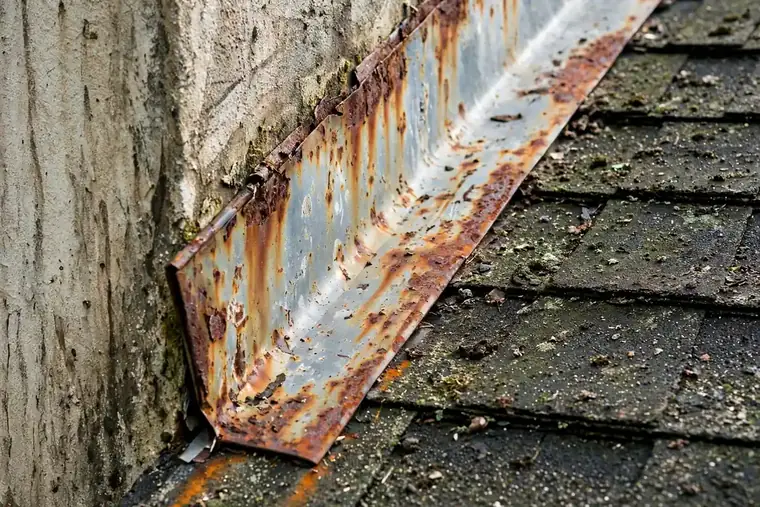
Ask a roofer what causes most leaks and you won't hear 'shingles' first — you'll hear 'flashing.' The thin metal that seals roof-to-wall joints, chimneys, valleys, and edges does the hardest waterproofing job on your roof, and it fails in predictable ways. Here are the seven most common, roughly in the order we encounter them around Severna Park.
One: corrosion. Standard galvanized flashing has a zinc coating that sacrifices itself to protect the steel — and eventually it's gone. On 1960s–70s homes in Chartwell and similar neighborhoods, the original flashing is simply rusted through after fifty-plus years. Near the water — Cypress Creek, Herald Harbor, Pasadena's Lake Shore — salt air accelerates the process dramatically. Rusted flashing isn't a maintenance issue; it's a replacement issue. No coating or sealant restores metal that's rusted through.
Two: the caulk-only 'repair.' Somewhere in every neighborhood there's a roof where a previous contractor smeared roofing caulk or silicone over failing flashing instead of replacing the metal. It looks waterproof for a season. Then UV breaks the caulk down, thermal movement cracks it, and water gets behind it — where it stays trapped against wood. We remove a lot of caulk in this business. Caulk is a gasket that assists flashing; it is not flashing.
Three: improper installation from day one. The classics: a single continuous strip bent against a wall instead of individual step pieces woven with each shingle course; counter-flashing glued to brick with construction adhesive instead of reglet-cut into mortar joints; headwall flashing with no end dams. These defects can hide for years behind paint and caulk, then fail all at once. Addition tie-ins are the worst offenders — the flashing where a new roof meets the old house is where shortcuts concentrate.
Four: thermal movement. Your roof and your walls expand and contract at different rates, every day, for decades. Flashing that bridges the joint has to flex; rigid, over-nailed, or fully adhered flashing eventually cracks or pulls its fasteners. This is why step flashing works — each small piece moves independently — and why long rigid runs fail. South and west exposures, with the biggest temperature swings, show this first.
Five: incompatible metals. Aluminum flashing in direct contact with steel, or copper touching galvanized steel, creates a galvanic cell — basically a tiny battery that eats the less noble metal. It looks like mysterious rapid corrosion at one joint while identical flashing elsewhere is fine. Waterfront air, with its salt spray, supercharges galvanic corrosion. Proper work separates dissimilar metals or uses compatible pairings throughout.
Six: physical damage. Ladders leaned against flashing, satellite installers screwing mounts through step flashing, falling limbs in wooded areas like Severna Forest, even aggressive pressure washing — flashing is thin by design, and it dents, punctures, and displaces easily. Every trade that touches your roof after the roofer leaves is a flashing risk; the dish installer doesn't think about your step flashing.
Seven: design omissions. Some roofs were simply never flashed correctly: no kick-out flashing where a roof dies into a sidewall (so runoff pours behind the siding), no cricket behind a wide chimney (so water ponds against the back wall), no pan flashing at dead valleys. These aren't failures of material — the detail was never there. The fix is adding the missing detail, which usually means opening up finished work to do it right.
What proper flashing work looks like: individual step pieces woven with each shingle course, counter-flashing mechanically locked into mortar joints (never glued to brick face), crickets behind wide chimneys, kick-out diverters at every roof-to-wall bottom, compatible metals throughout, and sealant used as a gasket at joints — not as the waterproofing itself. It's slow, hand-cut, hand-bent work, which is why it costs more than a caulk tube and lasts decades instead of seasons.
If you're seeing rust streaks, gaps at wall joints, or leaks that appear only in wind-driven rain, flashing is the prime suspect. Call (888) 974-0663 for a full flashing survey — we grade every flashing line on the roof, not just the one that's leaking, so you get the whole picture before spending anything. The survey takes under an hour and the written findings tell you exactly which lines are sound, which are aging, and which need work now.
Related Services
Roof Flashing Repair
Flashing — the metal that seals roof-to-wall joints, valleys, and edges — causes more leaks than shingles do. …
Chimney Flashing Repair
Chimneys are the single most leak-prone feature on a roof. Our chimney flashing repair in Severna Park, MD reb…
Find Us
Dealing with a leak right now? Call (888) 974-0663 — our call representatives answer 24/7 for emergencies.