
Roof Flashing Repair in Severna Park, MD
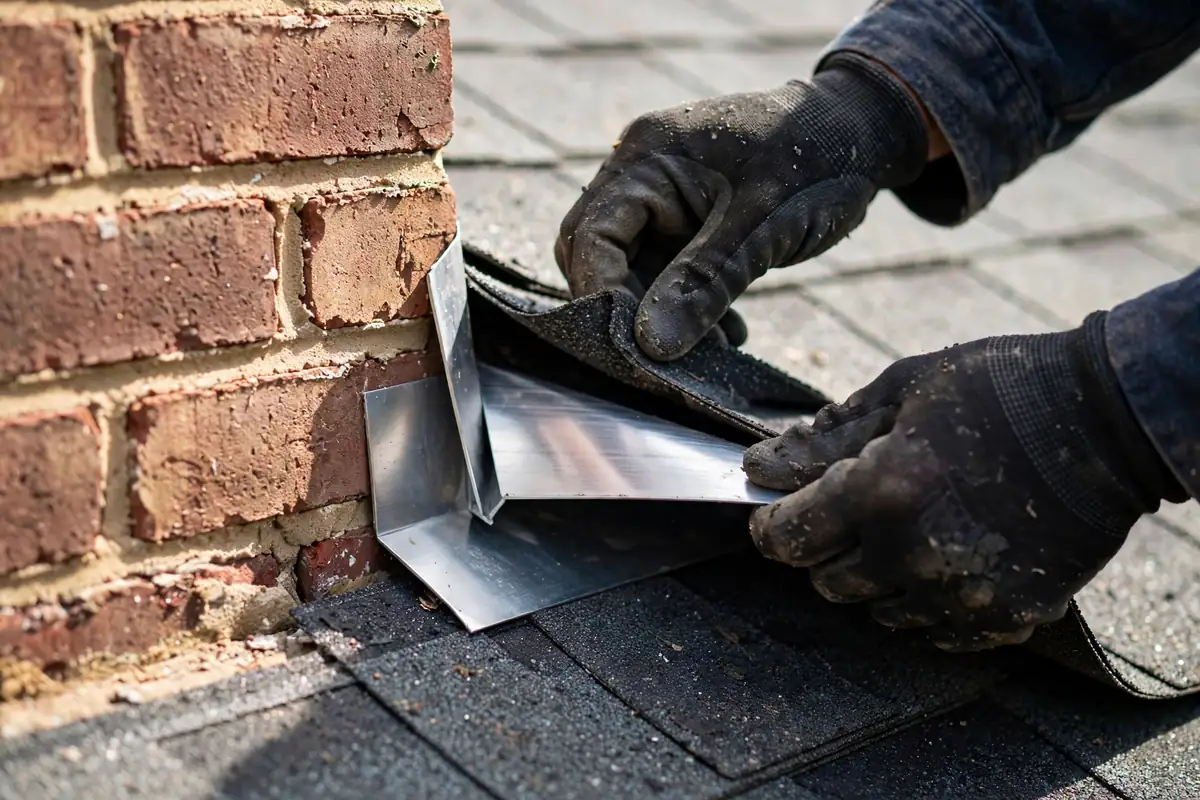
Flashing — the metal that seals roof-to-wall joints, valleys, and edges — causes more leaks than shingles do. Our roof flashing repair in Severna Park, MD replaces rusted, lifted, or missing flashing with properly stepped, sealed metalwork that moves water off the roof instead of into it.
In Severna Park, flashing failures follow the housing stock. The 1960s–70s brick ranchers in Chartwell and similar neighborhoods have original galvanized step flashing that's simply rusted through by now. Addition-heavy homes in Benfield and Round Bay have roof-to-wall tie-ins where the original flashing was never done right. Waterfront homes in Cypress Creek, Herald Harbor, and Pasadena's Lake Shore face salt-air corrosion that kills standard metals years early. And just about everywhere, we find the classic shortcut: a tube of caulk smeared over failed flashing instead of new metal. Caulk is a gasket, not a flashing — it buys months, not years.
Signs You Need Roof Flashing Repair
- Water stains on interior walls where the roof meets a dormer, addition, or chimney.
- Rust streaks running down from roof-to-wall joints or visible on the flashing itself.
- Flashing that has pulled away from the wall, leaving a visible gap.
- Caulk-only 'repairs' smeared over old flashing — a sign the underlying metal already failed.
- Leaks that appear only in wind-driven rain, when water is pushed sideways into joints.
- Missing kick-out flashing where a roof slope dies into a sidewall, with stained siding below.
Our Roof Flashing Repair Process
- Full flashing survey: step flashing, headwall, sidewall, valley, drip edge, and rake — every line is photographed and graded.
- Siding and shingle release: surrounding materials are carefully lifted so new flashing can integrate correctly, not just surface-mount.
- Old metal out: corroded or improperly installed flashing is removed back to sound material.
- New metal in: step flashing woven with each shingle course, headwall flashing with proper laps, and counter-flashing reglet-cut into masonry where applicable.
- Seal and integrate: joints are sealed, shingles and siding are reset, and the repair is water-tested with a hose before closeout.
Materials & Methods We Use
- 26-gauge galvanized or aluminum step flashing, sized to the shingle exposure.
- Copper or stainless options for waterfront homes where salt air eats standard metals.
- Lead or formable flashing for irregular masonry joints and old chimney shoulders.
- High-quality polyurethane sealant — never plain silicone smeared as a substitute for metal.
- Kick-out flashing diverters that throw runoff into the gutter instead of behind siding.
Safety on Every Visit
- Masonry reglet cuts are made with dust control and eye protection — silica dust is no joke.
- Siding is lifted, not torn; we carry the common local siding profiles' removal tools.
- Old flashing edges are sharp — cut-resistant gloves on every flashing job.
- Ladder stabilizers protect gutters and siding at every access point.
Roof Flashing Repair Across Our Service Area
We offer roof flashing repair in every community we serve. Pick your area for the local picture — housing, leak patterns, and scheduling:
Roof Flashing Repair in Arnold
Roof Flashing Repair for Arnold's Mix of 1970s–1990s subdivisions plus waterfront properties along the Severn River and cree
Arnold 21012Roof Flashing Repair in Benfield
Roof Flashing Repair for Benfield's Corridor along Benfield Road with a mix of older ranch homes and newer infill colonials on
Benfield 21146Roof Flashing Repair in Chartwell
Roof Flashing Repair for Chartwell's Planned 1960s–1970s community of brick ranchers and colonials with established landscaping
Chartwell 21146Roof Flashing Repair in Cypress Creek
Roof Flashing Repair for Cypress Creek's Waterfront community on Cypress Creek off the Magothy River. Mix of mid-century waterfront
Cypress Creek 21146Roof Flashing Repair in Herald Harbor
Roof Flashing Repair for Herald Harbor's Waterfront community on the Severn River mixing older fishing cottages with large newer re
Herald Harbor 21146Roof Flashing Repair in Millersville
Roof Flashing Repair for Millersville's 1980s-era subdivisions along the Veterans Highway corridor: two-story colonials and split-
Millersville 21108Roof Flashing Repair in Olde Severna Park
Roof Flashing Repair for Olde Severna Park's Historic core along Baltimore Annapolis Blvd: early-1900s bungalows, Cape Cods and America
Olde Severna Park 21146Roof Flashing Repair in Pasadena
Roof Flashing Repair for Pasadena's Lake Shore area of Pasadena: mix of older waterfront cottages on the Magothy River and Che
Pasadena 21122Roof Flashing Repair in Round Bay
Roof Flashing Repair for Round Bay's Waterfront community on the Severn River: mid-century homes, many renovated and expanded o
Round Bay 21146Roof Flashing Repair in Severn
Roof Flashing Repair for Severn's Inland community of townhomes and single-family homes, mostly 1990s–2000s construction nea
Severn 21144Roof Flashing Repair in Severna Forest
Roof Flashing Repair for Severna Forest's Wooded neighborhood off Jumpers Hole Road: homes tucked into heavy tree canopy on winding
Severna Forest 21146Roof Flashing Repair FAQs
Why does flashing fail before the shingles do?
Flashing is thinner metal doing a harder job — it bridges moving joints between different materials (roof to wall, roof to chimney) that expand and contract at different rates. Galvanized coatings wear off, caulk joints fatigue, and wind works edges loose. On a 25-year roof, expect flashing to need attention at least once mid-life.
Can't you just reseal the old flashing with caulk?
If the metal is sound and only the sealant joint failed, resealing is legitimate. But caulk over rusted-through or missing flashing is a bandage on a broken bone — it will leak again, usually at the worst time. We show you photos of the metal's actual condition so you can see which situation you're in.
What is step flashing and why does it matter?
Step flashing is a series of small L-shaped metal pieces woven between each shingle course where a roof meets a wall. Each piece overlaps the one below, so water steps down and off the roof. One continuous bent strip — the common shortcut — can't flex with the joint and eventually opens a channel straight into the house.
My siding is stained below a roof joint. Is that a flashing problem?
Very likely, especially if there's no kick-out flashing where the roof meets the wall. Without that small diverter, roof runoff pours behind the siding, rots the sheathing, and shows up as a 'roof leak' inside. The fix is proper kick-out flashing, not new siding.
How long does new flashing last?
Properly installed step and wall flashing lasts as long as the roof around it — 20-plus years. The sealant joints need inspection every few years, but the metal itself, correctly lapped and fastened, is a once-per-roof-lifetime component.
Do you replace flashing during a shingle repair?
We inspect it every time, and we recommend replacing flashing that's rusted, deformed, or improperly installed while the shingles are already lifted — it's far cheaper than coming back to tear into a finished repair later. Sound flashing stays put.
Roof Leaking? Don't Wait.
Every storm makes it worse. Call now and stop the water today.
Call Now — (888) 974-0663