
Questions to Ask a Roof Leak Contractor (Before You Hire)
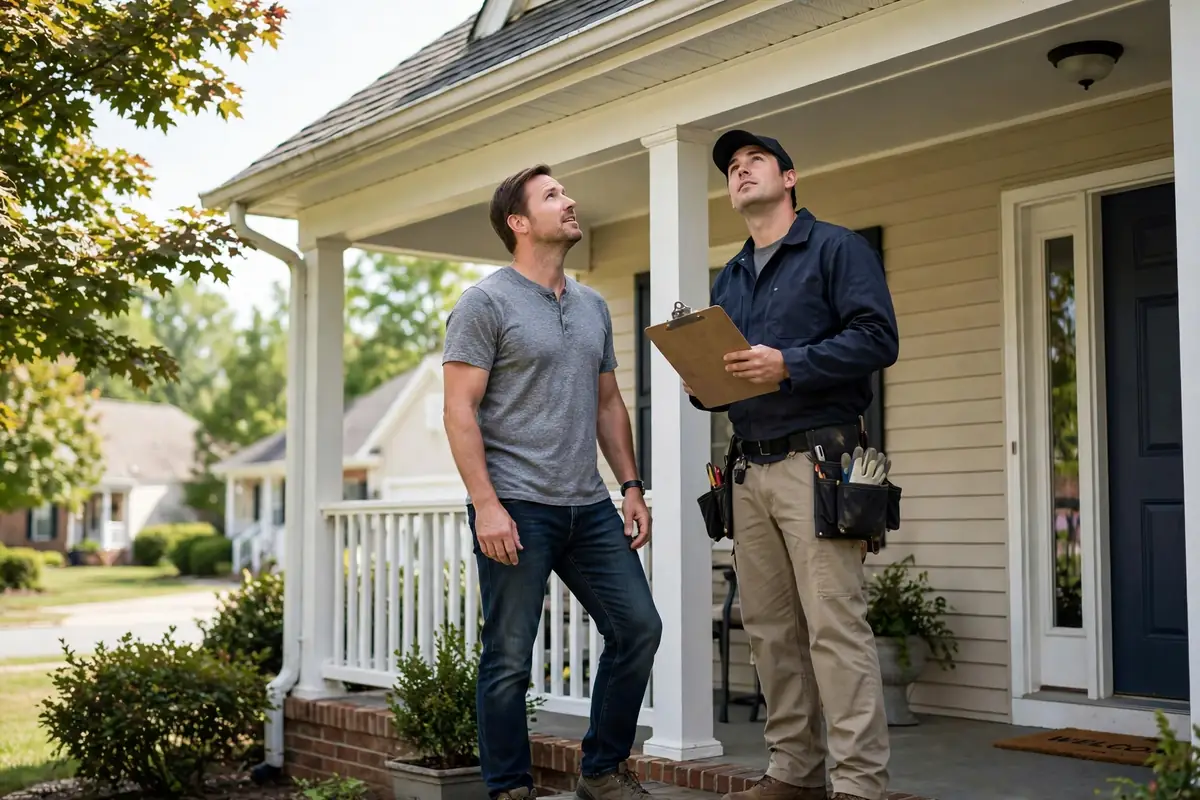
Most homeowners hire a roofer once or twice in a lifetime, which makes it hard to know what 'good' looks like. These are the questions that separate careful contractors from risky ones — what to ask, what a good answer sounds like, and the responses that should send you to the next estimate. (And yes — ask us these too. We welcome them.)
'What exactly is causing the leak, and can you show me?' The good answer includes photos from the roof, a plain-English explanation of the failure mechanism, and the entry point marked or described precisely. 'Your flashing is bad' without photos is a guess; 'here's the rusted-through step flashing at the chimney, and here's the water trail in the attic below it' is a diagnosis. Never hire a diagnosis you can't see. If a contractor can't show you the problem, they can't be sure they've fixed it either.
'Is this a repair situation or are you going to tell me I need a new roof?' Asked early, this question tests honesty. A trustworthy contractor answers with the roof's actual condition — age, field health, what's failing and what isn't — rather than defaulting to the biggest ticket. Be wary of anyone who declares 'you need a new roof' within five minutes of arriving, and equally wary of anyone who cheerfully patches an obviously finished roof for the third time. The right answer is specific to your roof, with evidence.
'What does your quote include, line by line?' A proper quote itemizes: the scope of work in plain language, materials (type and brand of shingles, flashing metal, underlayment), linear feet or squares where relevant, deck replacement terms (what happens and what it costs if rot is found), cleanup and disposal, and warranty terms. Vague quotes — 'fix leak: $850' — hide what's actually being done and make comparisons impossible. When comparing multiple quotes, the itemized one is almost always the honest one, even if it isn't the cheapest.
'What happens if you find rotted decking or worse once you open it up?' This is the change-order question, and it matters enormously on older Severna Park homes where multiple shingle layers hide deck condition. Good answer: 'We stop, photograph it, and requote before proceeding — you approve the additional work.' Bad answer: a shrug, or 'we'll handle it' without a price structure. Decking replacement is legitimate, common work; what's not legitimate is discovering it as a surprise surcharge after the fact.
'Can you match my shingles, and what if you can't?' Color matching matters for curb appeal and resale. Good contractors stock the common local colors and will tell you honestly when an exact match isn't available — then discuss options: closest match, replacing a larger section for uniformity, or living with a slight variation that weathers in. Anyone who promises a perfect invisible match on a 15-year-old roof is overselling; shingles weather, and even the same product looks different new versus aged.
'How do you handle flashing — repair or replace?' This question reveals philosophy. The caulk-and-pray contractor reseals everything; the thorough one replaces failed metal and reseals only sound joints. Ask specifically about step flashing at walls, chimney counter-flashing method (reglet-cut into mortar is correct; glued to brick face is not), and whether kick-out flashing will be installed where roofs meet walls. Flashing is where leaks live — a contractor vague about flashing is vague about the actual job.
'What's your warranty, and what does it actually cover?' Two warranties matter: the manufacturer's material warranty and the contractor's workmanship warranty. Ask how long the workmanship warranty runs, what triggers it (any leak at the repair site? any leak anywhere?), and whether it's written. Verbal warranties are worth the paper they're printed on. Also ask what voids it — some are voided if another contractor touches the roof. A one-year minimum workmanship warranty on repairs is standard; longer is better, but only if it's written.
'Are you insured, and can you prove it?' This is the question the task instructions remind homeowners to ask their contractor — and it's legitimate advice. Ask for a certificate of insurance showing general liability coverage, and confirm it's current. This protects you if a worker is injured or your property is damaged during the job. It's a reasonable, standard request; any contractor who gets defensive about it is telling you something.
Red flags that end the interview: demanding full payment upfront (deposits are normal; full prepayment is not); no physical local presence or only a PO box; pressure tactics — 'this price is only good today'; unwillingness to provide references or photos of past work; asking you to pull the permit or sign insurance paperwork you don't understand; and the classic — quoting a firm price over the phone without ever seeing the roof. Any one of these is enough to move on; two is a pattern.
The meta-advice: get two or three quotes, and don't automatically take the lowest. The lowest quote on a repair often means the least scope — caulk instead of metal, patch instead of rebuild. Compare scope first, price second. And trust the contractor who shows you the problem, explains the options including the cheaper one, and puts it all in writing. That's who you want on your roof.
When you're ready to ask us these questions, call (888) 974-0663. Bring the list — we'll answer every one, on your roof, with photos.
Related Services
Roof Leak Detection
Most roof leaks don't start where the stain appears. Our roof leak detection service in Severna Park, MD trace…
Chimney Flashing Repair
Chimneys are the single most leak-prone feature on a roof. Our chimney flashing repair in Severna Park, MD reb…
Find Us
Dealing with a leak right now? Call (888) 974-0663 — our call representatives answer 24/7 for emergencies.