
Roof Valley Leaks: Why Valleys Fail and How They're Fixed
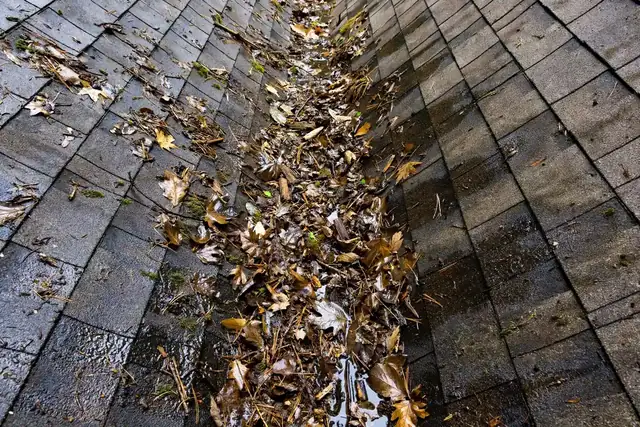
A roof valley — the inside corner where two slopes meet — is the hardest-working drainage feature on your home. It carries the combined runoff of both slopes, concentrates it into a narrow channel, and delivers it to the gutter. When anything in that chain is marginal, the valley is where it shows. Here are the five causes behind nearly every valley leak we repair around Severna Park.
Cause one: debris dams. In Severna Park's tree canopy — especially wooded neighborhoods like Severna Forest, Benfield, and the older Arnold sections — valleys fill with oak leaves, pine needles, and granule sediment every fall. The packed mat does two kinds of damage: it dams water so it backs up under the shingle edges, and it holds moisture against the valley metal and shingles for months, accelerating corrosion and rot. We've pulled literal compost out of neglected valleys. The frustrating part: the roof above and below the valley can be perfect — the valley fails from neglect alone. Annual valley clearing is the cheapest roof maintenance a wooded-lot homeowner can do.
Cause two: corroded valley metal. The metal lining the valley is thin by design, and it lives in the wettest spot on the roof. Galvanized valley metal from the 70s through the 90s eventually rusts through — first pinholes, then larger breaches, always hidden under the shingle edges until the leak appears inside. Salt air near the water shortens the timeline. Once the metal is perforated, no amount of shingle work above it matters; the valley needs new metal, full length, properly lapped.
Cause three: undersized metal. Many local homes were built with 12-inch valley flashing — which sounds adequate until you realize the shingles get cut back several inches on each side, leaving a working channel only a few inches wide. In a cloudburst, that channel can't carry two slopes' worth of water; it overtops, runs under the shingle cuts, and leaks. Modern practice is 24-inch metal, giving a real drainage channel even after the shingle cutback. When we rebuild a valley, the wider metal is non-negotiable — it's the difference between a valley that drains and one that merely decorates.
Cause four: shingles cut too close — or the 'closed' valley done wrong. In a closed-cut valley, one slope's shingles run through and the other's are cut in a straight line a couple inches from the center. Cut too close to the center, and water running down the valley wicks under the cut edge; cut crooked, and the waterline wanders onto the underlayment. Woven valleys have their own failure mode: the weave creates a thick, lumpy channel that traps debris. Either style, done poorly, leaks. Done well, both work — but in heavy-debris areas we generally recommend open metal valleys, where the channel is visible, cleanable, and inspectable.
Cause five: the dead valley. Additions and dormers create short valleys that dump into walls instead of gutters — 'dead' because the water has nowhere to go. These are design defects, not maintenance issues, and they're common on Severna Park's renovated homes in Round Bay, Herald Harbor, and Benfield, where decades of additions layered new valleys over old. A dead valley needs a cricket or diverter to throw water back onto the roof surface, plus kick-out flashing where it meets the wall. New metal alone won't fix a valley that was never given an exit.
How a proper valley repair goes: debris cleared first so the real condition is visible; failed metal replaced full-length with wide flashing over ice-and-water membrane; shingles cut back to a clean, straight waterline; the outlet at the gutter confirmed clear and adequately sized; and a flow test with a hose before closeout. It's a full-day job done right — the metalwork is hand-cut and every lap has to shed water in the right direction.
The valley is also where 'cheap quote' repairs fail most visibly. Smearing sealant along a valley's shingle edges, or laying new shingles over rusted metal, lasts one season if you're lucky. When you're comparing quotes for valley work, ask one question: 'Are you replacing the metal full-length, and how wide?' The right answer is yes, and 24 inches. Anything less is a patch with a short memory.
If stains are appearing below a valley line on your Severna Park home, call (888) 974-0663. We'll clear, inspect, and photograph the valley so you see exactly which of these five causes you're dealing with — and the fix will address the cause, not just the stain.
Related Services
Roof Valley Leak Repair
Valleys carry the combined runoff of two roof slopes, so any weakness there leaks fast and big. Our roof valle…
Drip Edge & Gutter Leak Repair
Water running behind the gutter or wicking back under the shingles rots fascia and leaks into walls. Our drip …
Find Us
Dealing with a leak right now? Call (888) 974-0663 — our call representatives answer 24/7 for emergencies.