
Tile Roof Leaks: Common Causes (and Why They're Different)
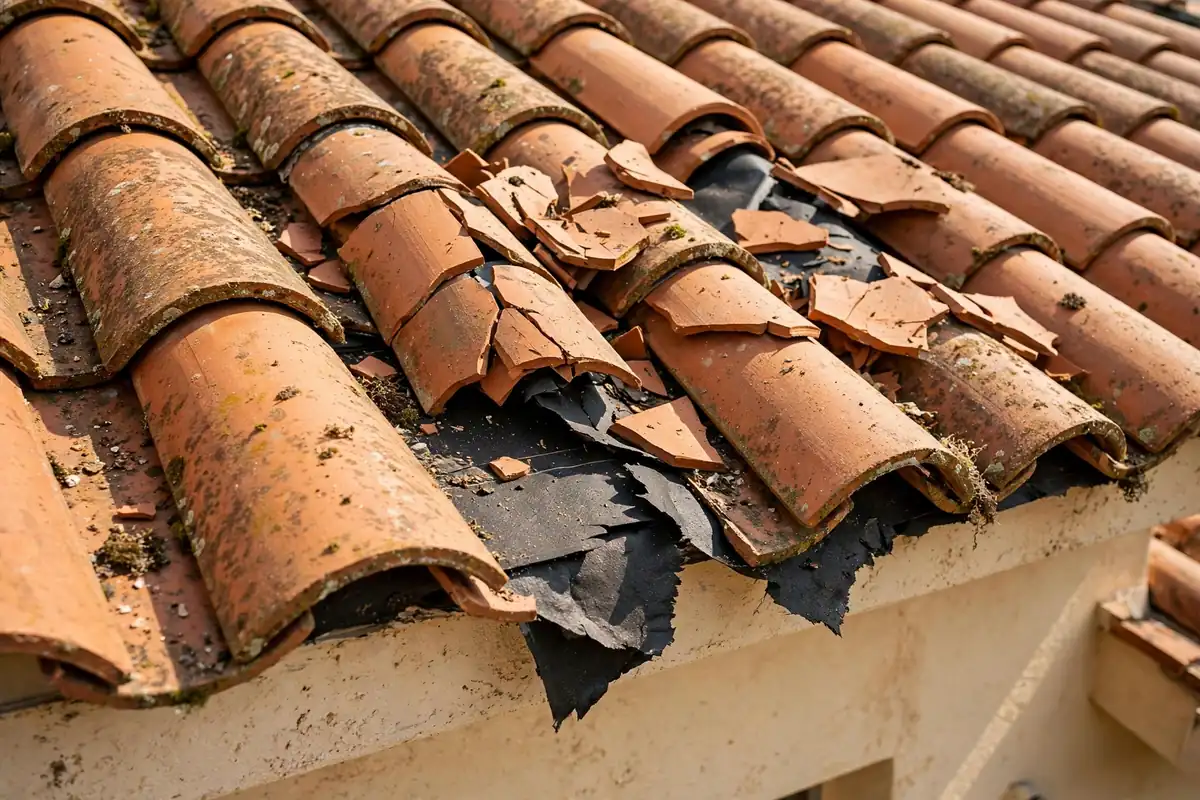
Tile roofs are uncommon in Severna Park — you'll spot them on a Mediterranean-style home here and there, far outnumbered by asphalt shingles. But tile leak calls come in regularly, and they confuse homeowners because tile roofs fail completely differently from shingle roofs. Understanding the difference saves you from the wrong repair.
The core concept: on a tile roof, the tiles are not the waterproofing. They're a durable, beautiful armor that sheds most water and takes the UV beating. The actual waterproofing is the underlayment beneath the tiles — historically felt, on modern installs a high-performance membrane. When a tile roof 'leaks,' what's almost always failed is the underlayment, the flashing, or the tile's ability to stay in place — not the tile material itself. A cracked tile alone rarely leaks; a failed underlayment under intact tiles leaks constantly. This is the opposite of shingle logic, where the shingle is the waterproofing layer.
Cause one: underlayment failure. This is the big one, and it's a matter of age. Felt underlayment under tile lasts 20 to 30 years — while the tiles themselves last 50-plus. So a 30-year-old tile roof often has perfect tiles over disintegrating felt. Water that gets past the tiles (which is normal — tiles aren't sealed) hits failed underlayment and comes through. The fix isn't replacing tiles; it's a 'lift and relay' — tiles carefully removed and stacked, new underlayment installed, tiles reinstalled with broken ones replaced. It's labor-intensive, which is why tile underlayment jobs cost multiples of shingle repairs.
Cause two: slipped, broken, or missing tiles exposing the underlayment. Tiles slip when their fasteners corrode or when the battens they hang on rot; they break from foot traffic (the number-one cause — tile is strong under distributed load and fragile under a careless footstep), falling limbs, or freeze-thaw. A single missing tile isn't an emergency — the underlayment handles it briefly — but every missing tile accelerates underlayment aging in that spot, and a cluster of them is a leak waiting for the next storm. Walking a tile roof without knowing the load paths is how most tile damage happens, including by other trades.
Cause three: flashing failures at the same old places. Valleys, chimneys, walls, skylights — tile doesn't change the fact that transitions need metal. Tile valleys use the same wide-metal principle as shingle valleys, and they clog with debris the same way. Headwall and sidewall flashing on tile roofs is more complex (the flashing has to work with the tile profile), and it's where shortcuts show. Mortar-set ridge and hip caps crack with thermal movement; modern foam-adhesive resets last longer.
Cause four: debris and moss in the tile channels. Tile profiles create channels that collect leaves, pine needles, and granule-like tile dust. In Severna Park's tree cover, neglected tile roofs grow impressive compost in their valleys and behind chimneys. Trapped debris holds water against the underlayment and wicks it sideways — and on tile, the debris is hidden under the tile laps, so homeowners don't see it accumulating. The shaded, slow-drying conditions also grow moss that lifts tiles and opens the laps.
Cause five: battens and fastener decay. Tiles hang on wooden battens nailed to the deck; when battens rot (usually from long-term minor underlayment seepage), tiles slip in rows. Corroded fasteners let tiles shift in wind. These are the failures that turn a maintenance issue into a structural-feeling problem — a whole slope of tiles migrating downhill looks alarming, but it's usually battens and fasteners, fixed during the lift-and-relay.
What tile repair actually involves — and why it costs more. Every tile repair starts with careful tile removal: tiles are lifted, stacked, and protected, because breaking good tiles is expensive (matching discontinued profiles is genuinely hard). Then the underlayment or flashing work happens exactly like a flat-roof repair — membrane, laps, details. Then tiles go back, with replacements for the broken ones. The material cost is modest; the labor is the job. Anyone quoting tile work at shingle prices is planning to cut the corners that matter — usually by smearing sealant over the tiles instead of addressing the underlayment.
Can you DIY tile repair? More than most roofing, the answer is no — not because the concepts are complex, but because the execution punishes inexperience. One wrong footstep breaks five tiles. Mis-set tiles channel water into the underlayment. And the underlayment work itself is membrane roofing, a separate trade skill. Tile is a 'call the specialist' roof, and in our area that specialist needs to actually have tile experience — shingle-only crews learn on your roof, and tile shows every lesson.
If your Severna Park-area tile roof is leaking, call (888) 974-0663 and tell us it's tile — we'll send the assessment with tile-specific eyes: underlayment age, batten condition, flashing details, and a tile inventory for matching. The tiles may outlive us all; it's everything underneath that needs the attention.
Related Services
Roof Leak Detection
Most roof leaks don't start where the stain appears. Our roof leak detection service in Severna Park, MD trace…
Roof Valley Leak Repair
Valleys carry the combined runoff of two roof slopes, so any weakness there leaks fast and big. Our roof valle…
Find Us
Dealing with a leak right now? Call (888) 974-0663 — our call representatives answer 24/7 for emergencies.