
Why Roofs Leak in Heavy Rain (But Not Light Rain)
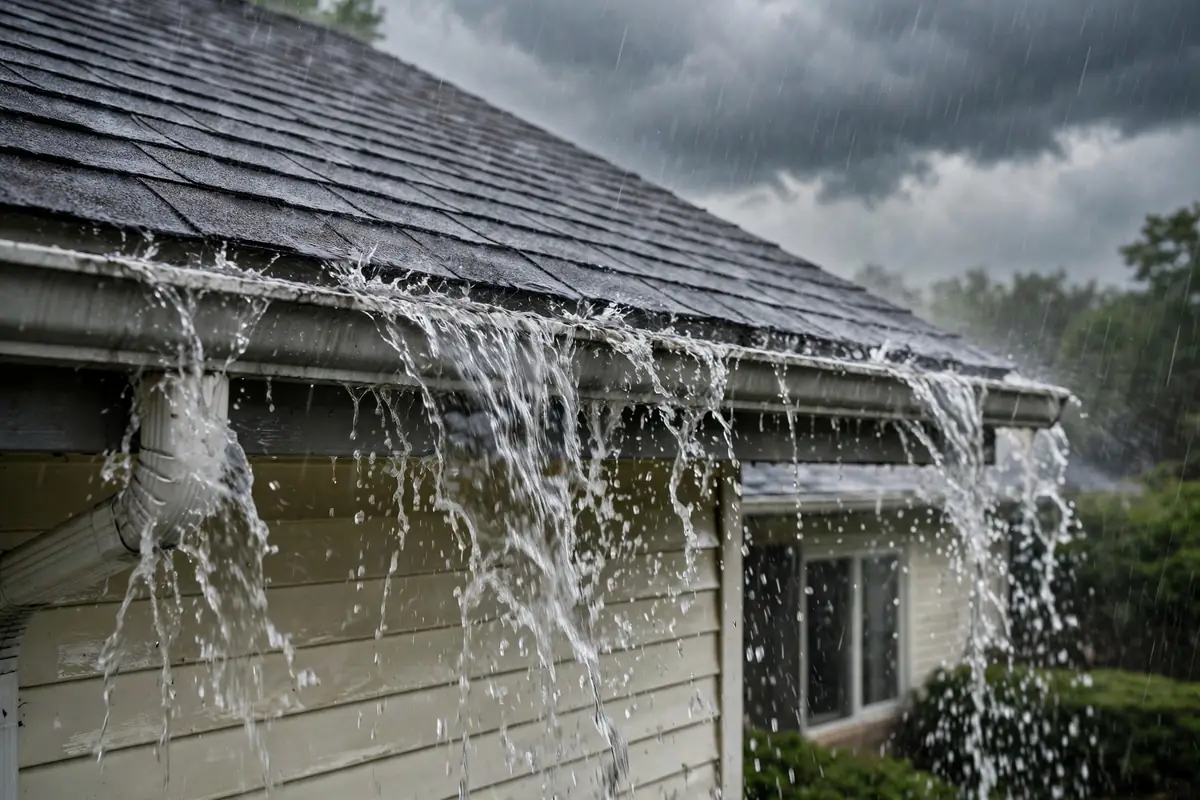
It's one of the most common things homeowners tell us: 'It only leaks when it really pours.' The roof seems fine nine days out of ten, then a cloudburst finds the weakness. This isn't mysterious — heavy rain tests your roof in ways light rain simply doesn't, and understanding the difference tells you exactly what kind of failure you're dealing with.
Volume overwhelms marginal drainage. A roof valley drains two full slopes; in light rain it handles the flow easily, but in a cloudburst the volume can exceed what a debris-narrowed or undersized valley can carry. Water backs up, rises over flashing laps, and enters where the laps were never designed to be submerged. The same principle applies at gutters: a gutter that's merely slow-draining in normal rain becomes a dam in a downpour, and water backs up under the drip edge and into the eave. If your leak appears only in the heaviest rain and sits below a valley or eave, drainage capacity — not a hole — is the prime suspect.
Wind changes the angle of attack. Heavy rain in the Severna Park area rarely falls straight down — it comes with gusty wind off the Chesapeake and its rivers. Wind-driven rain hits the roof at an angle, pushing water sideways and even uphill under shingle laps and flashing edges that shed vertical rain perfectly. This is why ridge caps, rake edges, and wall flashing are classic wind-only leak points: the laps are designed for gravity drainage, and wind defeats gravity. Waterfront homes in Herald Harbor, Cypress Creek, and Pasadena's Lake Shore see this worst, but any home takes wind-driven rain in a nor'easter.
Pressure finds the pinholes. Light rain flows over small defects; heavy rain ponds against them. A pinhole in valley metal, a hairline crack in a pipe boot, a slightly lifted shingle tab — in drizzle, surface tension and gravity carry water past these flaws. In a downpour, water piles up, hydrostatic pressure builds, and the flaw becomes a funnel. This is also why leaks that 'only happen in heavy rain' get worse over time: each cycle works the defect a little larger.
Saturation defeats absorbent materials. Older underlayment, weathered shingle mats, and wood flashing substrates can absorb light rain and dry out between events. Sustained heavy rain saturates them, and once saturated, they pass water through. This is particularly true of the felt underlayment under older roofs in neighborhoods like Chartwell and Olde Severna Park — decades of heat cycling have made it brittle and porous, fine in drizzle, a sieve in a deluge.
What this means for diagnosis: rain-only-in-downpours leaks need to be tested accordingly. A hose test that gently wets the roof won't reproduce them — the test has to simulate volume and wind direction. When we water-test a heavy-rain-only leak, we concentrate flow on one suspect area at a time and angle the spray to mimic wind. Homeowners trying DIY diagnosis should know this: if your gentle hose test found nothing, you haven't ruled anything out.
The fix depends on which mechanism is at work. Drainage-capacity leaks need wider valleys, cleared debris, bigger gutter outlets, or added downspouts. Wind-entry leaks need flashing rebuilds with proper laps and sealed edges — and sometimes simply hand-sealing lifted shingle tabs. Pinhole and saturation failures need material replacement: new valley metal, new boots, new underlayment in the affected zone. A roofer who understands the mechanism fixes it once; one who just patches the stain fixes it until the next cloudburst.
One warning: 'only in heavy rain' is a stage, not a stable condition. Every cycle enlarges the defect slightly — the pinhole becomes a hole, the lifted tab tears, the saturated underlayment rots. The leak that only shows in downpours this year shows in ordinary rain next year. The dry spell after a storm is the cheapest time to fix it; waiting for it to get worse is the most expensive strategy in roofing.
If your Severna Park home leaks only when it pours, call (888) 974-0663 and describe the pattern — when it leaks, where the stain sits, and what the wind was doing. The pattern is the diagnosis half-done, and it tells us exactly where to look first.
Related Services
Roof Valley Leak Repair
Valleys carry the combined runoff of two roof slopes, so any weakness there leaks fast and big. Our roof valle…
Drip Edge & Gutter Leak Repair
Water running behind the gutter or wicking back under the shingles rots fascia and leaks into walls. Our drip …
Find Us
Dealing with a leak right now? Call (888) 974-0663 — our call representatives answer 24/7 for emergencies.