
Chimney Flashing Repair in Chartwell, MD 21146
Chimneys are the single most leak-prone feature on a roof. Our chimney flashing repair in Severna Park, MD rebuilds the full flashing system — step flashing, counter-flashing reglet-cut into mortar, cricket saddles, and crown sealing — so water goes around the chimney, not into your house. In Chartwell, that work meets planned 1960s–1970s community of brick ranchers and colonials with established landscaping. Most homes are on their second or third roof; original builders used basic 3-tab shingles and galvanized flashing. Because of that housing mix — and typical Severna Park pattern: summer thunderstorms with driving rain, winter freeze-thaw cycling, occasional tropical-storm remnants. — chimney flashing repair here follows the patterns described below, not a generic checklist.
What that means in practice: the failure patterns we see most in Chartwell drive how we scope chimney flashing repair here. Original galvanized step flashing from the 60s/70s is usually rusted through by now — flashing replacement, not just shingle work, is routine on these homes. That local read — housing age, tree cover, water exposure, and how chartwell's roofs were built — shapes the estimate you get, the materials we bring on the truck, and the order we work in. The sections below walk through exactly what to watch for, how the job runs, and how long it takes on a typical chartwell home.
Signs You Need Chimney Flashing Repair in Chartwell
- Water stains on the ceiling or wall near the fireplace or chimney breast.
- White efflorescence stains on the chimney's exterior brick.
- Rust streaks on the chimney or roof below the flashing line.
- Spalling or flaking brick faces near the roofline.
- A damp, musty smell from the fireplace in rainy weather.
- Visible gaps between the flashing and the chimney masonry.
Our Chimney Flashing Repair Process in Chartwell
- Chimney assessment: flashing condition, mortar joint soundness, crown condition, and flue liner exposure are all documented — flashing can't be fixed properly on a crumbling chimney.
- Shingle release around the base: two to three courses are lifted back to expose the full flashing zone.
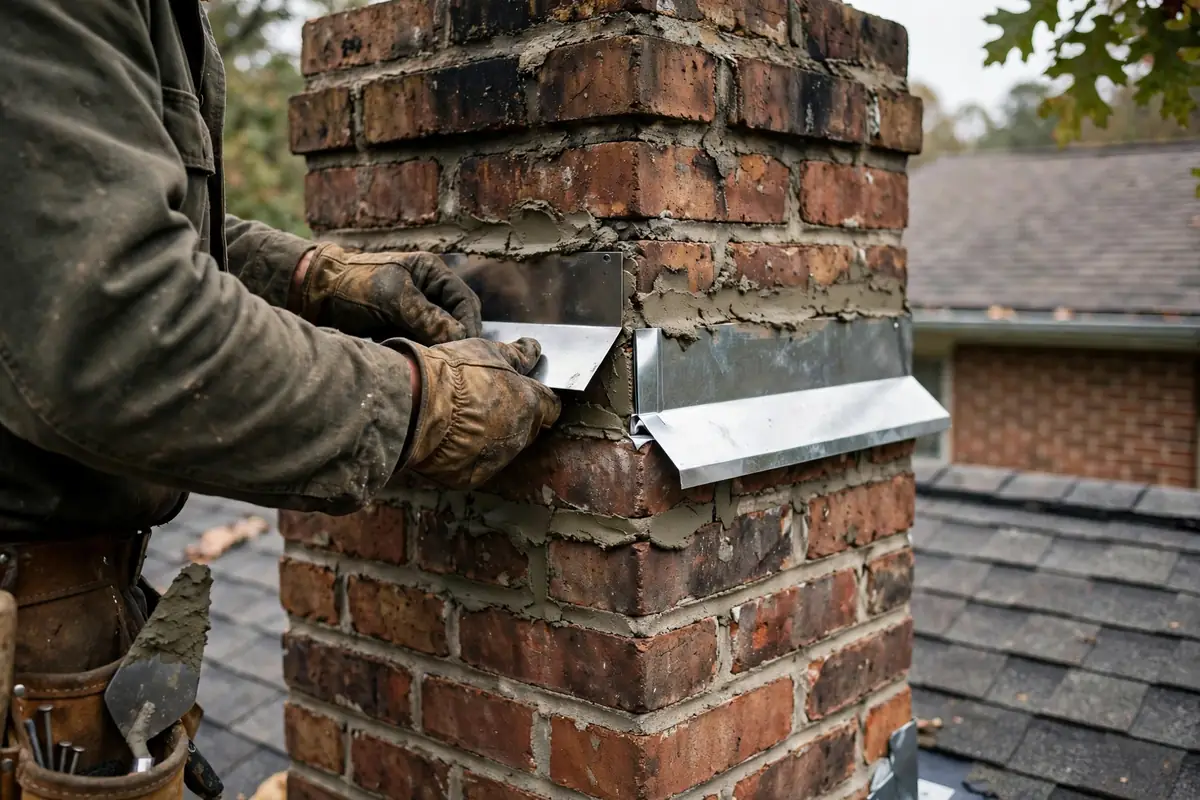
- Step flashing rebuild: new step pieces woven with each shingle course up both sides of the chimney.
- Counter-flashing: new metal reglet-cut and locked into raked mortar joints, sealed — never surface-glued to brick.
- Cricket and crown: a cricket saddle is added on the upslope side of wide chimneys; the crown is sealed or rebuilt so water can't enter from the top.
How Chartwell Changes This Work
Chimney Flashing Repair isn't the same job everywhere — chartwell's housing and exposure change what we check, what materials we choose, and where we look first:
- Original galvanized step flashing from the 60s/70s is usually rusted through by now — flashing replacement, not just shingle work, is routine on these homes.
- Brick veneer walls mean counter-flashing must be reglet-cut into mortar joints; surface-mounted flashing fails early here.
- Many homes have original masonry chimneys with deteriorated mortar crowns — chimney flashing rebuilds pair naturally with crown repair.
- Low-pitch ranch sections over garages and porches often leak at the transition; those get membrane-compatible detailing.
Two of those factors deserve emphasis because they most often decide whether chimney flashing repair succeeds long-term in Chartwell. First, water exposure: storm exposure here is real — driving rain finds every weak lap, so flashing details get marine-grade attention even away from the water, which is why we default to corrosion-resistant metals and wider laps on chartwell jobs. Second, access and staging: Baltimore Annapolis Blvd (MD-648), Chartwell-area side streets off the B&A corridor routing keeps scheduling tight, but established landscaping means we plan protection and staging before the first shingle comes off. Both show up in your written estimate as line items, not surprises.
Materials & Methods
- Step flashing sized to shingle exposure, in galvanized, aluminum, or copper.
- Counter-flashing with a proper reglet bend that locks into a mortar joint cut.
- Cricket framing lumber and membrane for the upslope diverter on chimneys wider than 30 inches.
- Masonry crown sealant or crown rebuild mix where the crown is cracked.
- Polyurethane sealant for reglet joints — flexible enough to move with the chimney.
Chartwell Snapshot
Chartwell (21146) sits in Anne Arundel County, accessed via Baltimore Annapolis Blvd (MD-648), Chartwell-area side streets off the B&A corridor. Planned 1960s–1970s community of brick ranchers and colonials with established landscaping. Most homes are on their second or third roof; original builders used basic 3-tab shingles and galvanized flashing. Typical Severna Park pattern: summer thunderstorms with driving rain, winter freeze-thaw cycling, occasional tropical-storm remnants. For chimney flashing repair specifically, that profile tells us which failure modes to rule out first — and it is why two chartwell estimates for the same service can legitimately differ: the roof's age, exposure, and access shape the scope before we ever climb the ladder.
How Long Does Chimney Flashing Repair Take in Chartwell?
A chimney flashing rebuild usually takes a half to a full day: shingle release, new step flashing, reglet-cut counter-flashing, and reset. Add time for cricket construction or crown work, which are quoted separately.
Scheduling in Chartwell is straightforward: we route via Baltimore Annapolis Blvd (MD-648), Chartwell-area side streets off the B&A corridor, and chartwell sits inside our core service area with the same priority as Severna Park itself. Emergency calls jump the schedule regardless of neighborhood. For non-emergency work, dry-weather scheduling gets you the earliest slot — and the most thorough job, since chimney flashing repair can't be properly water-tested on a soaked roof. When you call, tell us your ZIP (21146) and where the water is showing; that lets us arrive with the right materials for chartwell's housing — whether that's matching shingles for the local subdivisions, corrosion-resistant flashing for waterfront exposure, or wide valley metal for the tree-heavy streets. Photos of the stain and the roof area above it, texted ahead if you can, make the first visit even more productive.
Safety Notes
- Chimney work is steep-slope work: roof jacks, staging, and harnesses are standard, not optional.
- Masonry dust control during reglet cutting — respirators and eye protection.
- Old lead flashing is handled with gloves and disposed of properly, not left in the yard.
- We verify the flue is clear and capped before sealing the crown — a sealed crown with a blocked flue is a carbon monoxide risk.
Related Pages
Chimney Flashing Repair — All Areas
How this service works across Severna Park and Anne Arundel County.
Roof Leak Repair in Chartwell
All leak repair services available in Chartwell, MD 21146.
Emergency Roof Leak Repair in Chartwell
When water is coming in now, waiting is not an option. Our emergency roof leak repair service in Sev…
Roof Leak Detection in Chartwell
Most roof leaks don't start where the stain appears. Our roof leak detection service in Severna Park…
Shingle Roof Leak Repair in Chartwell
Cracked, curled, or wind-torn shingles let water straight through to the deck. Our shingle roof leak…
Chimney Flashing Repair in Chartwell FAQs
Is the leak really the flashing, or is my chimney itself bad?
Both are possible, and we check both before quoting. Soft mortar, a cracked crown, or spalling brick can admit water directly — new flashing won't fix that. Our assessment covers the masonry too, and if the chimney needs masonry work first, we'll tell you plainly rather than sell you flashing alone.
What is a chimney cricket and do I need one?
A cricket is a small peaked diverter built on the upslope side of a wide chimney that splits roof runoff around both sides. Without one, water and debris pile against the chimney's back wall — the number-one chimney leak spot. Any chimney wider than about 30 inches should have one.
Why can't you just caulk around the chimney?
Caulk can't bridge the joint between a moving roof and a rigid masonry chimney for long. Thermal expansion opens the joint, UV breaks the caulk down, and water gets behind it — where it stays trapped and rots things quietly. Proper metal flashing with a reglet-locked counter-flashing is the permanent answer.
How long does a chimney flashing rebuild take?
Most single chimneys take a half to a full day: shingle release, step flashing, reglet-cut counter-flashing, and reset. Add time for cricket construction or crown work. Masonry repairs like tuckpointing are quoted separately.
What roof leak problems are most common in Chartwell?
Original galvanized step flashing from the 60s/70s is usually rusted through by now — flashing replacement, not just shingle work, is routine on these homes. Brick veneer walls mean counter-flashing must be reglet-cut into mortar joints; surface-mounted flashing fails early here.
How do Chartwell's homes affect roof leak repair?
Planned 1960s–1970s community of brick ranchers and colonials with established landscaping. Most homes are on their second or third roof; original builders used basic 3-tab shingles and galvanized flashing. That housing mix shapes the work: Many homes have original masonry chimneys with deteriorated mortar crowns — chimney flashing rebuilds pair naturally with crown repair.
Roof Leaking? Don't Wait.
Every storm makes it worse. Call now and stop the water today.
Call Now — (888) 974-0663