
Flat Roof Leak Repair in Arnold, MD 21012
Flat and low-slope roofs don't shed water — they have to waterproof it. Our flat roof leak repair in Severna Park, MD finds failed seams, punctures, and ponding spots on membrane and rolled roofs, then welds, patches, or recoats for a watertight surface that drains. In Arnold, that work meets mix of 1970s–1990s subdivisions plus waterfront properties along the Severn River and creeks off the Broadneck Peninsula. Colonials, split-levels and ranches; many original roofs now at or past the 20–25 year mark. Because of that housing mix — and exposed to nor'easters and tropical-system remnants moving up the Chesapeake; wind-driven rain is the top leak trigger. Mature tree canopy drops heavy debris into valleys and gutters each fall. — flat roof leak repair here follows the patterns described below, not a generic checklist.
What that means in practice: the failure patterns we see most in Arnold drive how we scope flat roof leak repair here. Waterfront-edge homes see wind-driven rain forced under shingle edges and ridge caps — step and headwall flashing gets a harder look here than inland. That local read — housing age, tree cover, water exposure, and how arnold's roofs were built — shapes the estimate you get, the materials we bring on the truck, and the order we work in. The sections below walk through exactly what to watch for, how the job runs, and how long it takes on a typical arnold home.
Signs You Need Flat Roof Leak Repair in Arnold
- Ponding water that stands more than 48 hours after rain.
- Blisters or bubbles in the membrane surface.
- Seams that are lifting, curling, or visibly separated.
- Stains on the ceiling below a flat section, often far from any edge.
- Cracked or alligatored coating on an older rolled roof.
- Debris-clogged drains or scuppers with water backed up around them.
Our Flat Roof Leak Repair Process in Arnold
- Drainage survey: we map how water is supposed to leave the roof — drains, scuppers, slope — and find where it actually ponds.
- Membrane inspection: seams, penetrations, and flashings are probed; suspect areas are marked, not guessed at.
- Core check: where saturation is suspected, a small core reveals whether the insulation below is wet — wet insulation must be replaced, not covered.
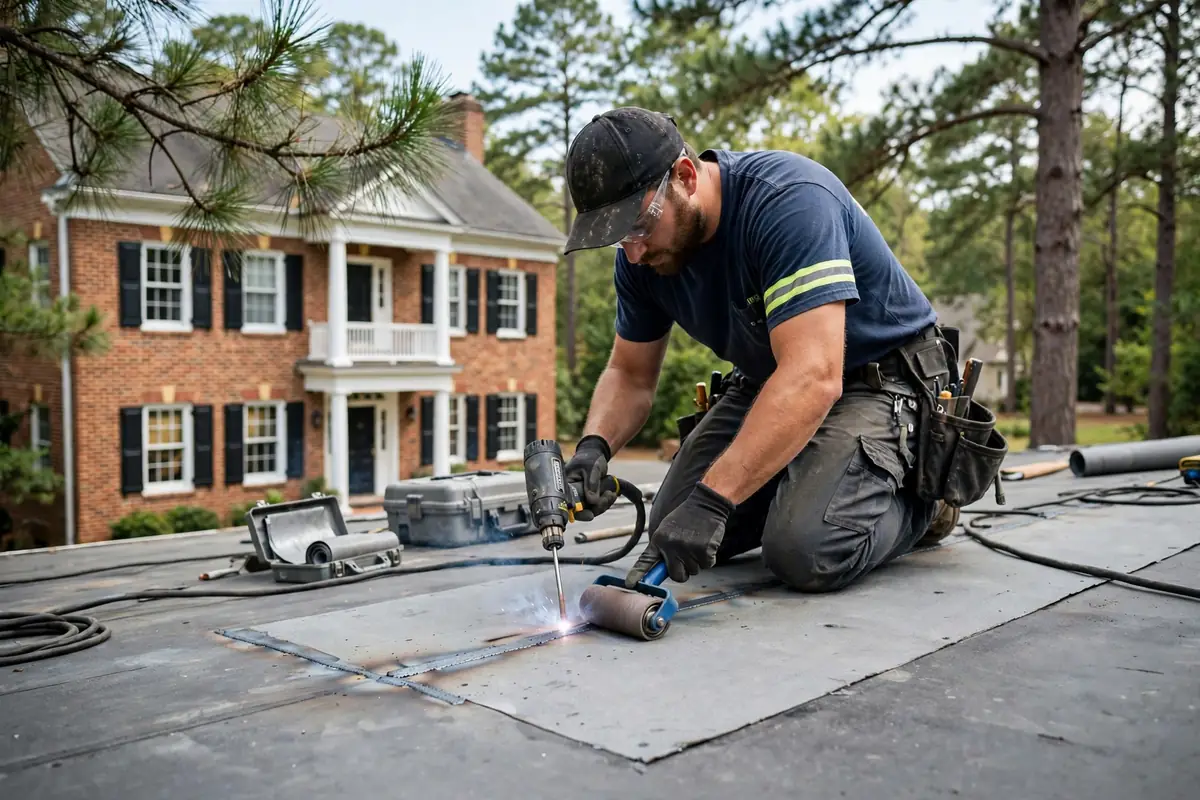
- Repair: heat-welded patches on single-ply, new membrane sections on modified bitumen, proper flashing rebuilds at curbs and walls.
- Drainage correction: clogged drains cleared, and where ponding is structural, tapered solutions or additional drainage are proposed.
How Arnold Changes This Work
Flat Roof Leak Repair isn't the same job everywhere — arnold's housing and exposure change what we check, what materials we choose, and where we look first:
- Waterfront-edge homes see wind-driven rain forced under shingle edges and ridge caps — step and headwall flashing gets a harder look here than inland.
- Mature oaks and pines shed limbs and leaf mats into roof valleys; valley metal stays damp and corrodes faster, so valley inspections focus on rust-through and debris dams.
- Many 1980s subdivisions still carry their second shingle layer; tear-off condition of the deck can't be assumed until the old layers come up.
- College Parkway corridor homes with tall pines: pine needles clog gutters and cause backup leaks at the drip edge, often mistaken for roof failure.
Two of those factors deserve emphasis because they most often decide whether flat roof leak repair succeeds long-term in Arnold. First, water exposure: storm exposure here is real — driving rain finds every weak lap, so flashing details get marine-grade attention even away from the water, which is why we default to corrosion-resistant metals and wider laps on arnold jobs. Second, access and staging: College Parkway, Ritchie Highway (MD-2), Baltimore Annapolis Blvd (MD-648) routing keeps scheduling tight, but wooded lots mean we plan debris management and ladder placement around mature trees. Both show up in your written estimate as line items, not surprises.
Materials & Methods
- Heat-weldable membrane patches matched to the existing single-ply system.
- Modified bitumen repair membrane with proper primer for torch-free application.
- Pourable sealer and pitch pans for irregular penetrations.
- Replacement tapered insulation to correct ponding where structure allows.
- Elastomeric coating systems for sound-but-aging surfaces that need a renewed top layer.
Arnold Snapshot
Arnold (21012) sits in Anne Arundel County, accessed via College Parkway, Ritchie Highway (MD-2), Baltimore Annapolis Blvd (MD-648). Mix of 1970s–1990s subdivisions plus waterfront properties along the Severn River and creeks off the Broadneck Peninsula. Colonials, split-levels and ranches; many original roofs now at or past the 20–25 year mark. Exposed to nor'easters and tropical-system remnants moving up the Chesapeake; wind-driven rain is the top leak trigger. Mature tree canopy drops heavy debris into valleys and gutters each fall. For flat roof leak repair specifically, that profile tells us which failure modes to rule out first — and it is why two arnold estimates for the same service can legitimately differ: the roof's age, exposure, and access shape the scope before we ever climb the ladder.
How Long Does Flat Roof Leak Repair Take in Arnold?
Membrane repairs usually take a full day: surface prep, heat-welded or adhered patches, flashing rebuilds at curbs and walls, and drainage correction. The welding itself is methodical and can't be rushed.
Scheduling in Arnold is straightforward: we route via College Parkway, Ritchie Highway (MD-2), Baltimore Annapolis Blvd (MD-648), and arnold sits inside our core service area with the same priority as Severna Park itself. Emergency calls jump the schedule regardless of neighborhood. For non-emergency work, dry-weather scheduling gets you the earliest slot — and the most thorough job, since flat roof leak repair can't be properly water-tested on a soaked roof. When you call, tell us your ZIP (21012) and where the water is showing; that lets us arrive with the right materials for arnold's housing — whether that's matching shingles for the local subdivisions, corrosion-resistant flashing for waterfront exposure, or wide valley metal for the tree-heavy streets. Photos of the stain and the roof area above it, texted ahead if you can, make the first visit even more productive.
Safety Notes
- Flat roofs hide soft spots — every step is tested, and suspect areas are probed before weighting them.
- Parapet edges get the same fall protection as steep slopes; 'flat' doesn't mean safe.
- Heat welding is done with fire watch protocol: extinguisher on the roof, no open flame near penetrations.
- Drains are cleared from the roof side with the discharge point confirmed — backed-up drains can release suddenly.
Related Pages
Flat Roof Leak Repair — All Areas
How this service works across Severna Park and Anne Arundel County.
Roof Leak Repair in Arnold
All leak repair services available in Arnold, MD 21012.
Emergency Roof Leak Repair in Arnold
When water is coming in now, waiting is not an option. Our emergency roof leak repair service in Sev…
Roof Leak Detection in Arnold
Most roof leaks don't start where the stain appears. Our roof leak detection service in Severna Park…
Shingle Roof Leak Repair in Arnold
Cracked, curled, or wind-torn shingles let water straight through to the deck. Our shingle roof leak…
Flat Roof Leak Repair in Arnold FAQs
Can you repair a flat roof, or does it need replacing?
It depends on the membrane's overall condition and whether the insulation below is wet. Isolated seam failures, punctures, and flashing problems on an otherwise sound membrane are very repairable. Widespread blistering, saturated insulation, or a membrane past its life means replacement is the honest answer — we'll show you core samples so it's not just our word.
Why does water pond on my flat roof?
Because 'flat' roofs are built with slight slopes to drains, and that slope gets defeated over time — structural settling, compressed insulation, or drains installed too high. Water standing more than 48 hours accelerates membrane breakdown. We map the ponding and propose drainage correction, not just patching.
Is coating a good fix for my flat roof?
Coating is a maintenance layer, not a structural repair. On a sound, dry membrane with minor weathering, an elastomeric coating extends life nicely. Over wet insulation or failed seams, coating just hides the problem until it fails bigger. We test before we recommend.
How do you find a leak on a flat roof?
Systematically: drainage mapping, seam-by-seam probing, penetration checks, and core samples where saturation is suspected. Electronic leak detection has its place on large membranes, but on residential flat sections, methodical physical inspection finds it.
What roof leak problems are most common in Arnold?
Waterfront-edge homes see wind-driven rain forced under shingle edges and ridge caps — step and headwall flashing gets a harder look here than inland. Mature oaks and pines shed limbs and leaf mats into roof valleys; valley metal stays damp and corrodes faster, so valley inspections focus on rust-through and debris dams.
How do Arnold's homes affect roof leak repair?
Mix of 1970s–1990s subdivisions plus waterfront properties along the Severn River and creeks off the Broadneck Peninsula. Colonials, split-levels and ranches; many original roofs now at or past the 20–25 year mark. That housing mix shapes the work: Many 1980s subdivisions still carry their second shingle layer; tear-off condition of the deck can't be assumed until the old layers come up.
Roof Leaking? Don't Wait.
Every storm makes it worse. Call now and stop the water today.
Call Now — (888) 974-0663