
Pipe Boot Repair in Arnold, MD 21012
The rubber boot around a plumbing vent pipe cracks in the sun, and suddenly every rain finds its way in. Our pipe boot repair in Severna Park, MD replaces failed boots with long-life lead or high-grade synthetic boots — a small fix that stops one of the most common leaks we see. In Arnold, that work meets mix of 1970s–1990s subdivisions plus waterfront properties along the Severn River and creeks off the Broadneck Peninsula. Colonials, split-levels and ranches; many original roofs now at or past the 20–25 year mark. Because of that housing mix — and exposed to nor'easters and tropical-system remnants moving up the Chesapeake; wind-driven rain is the top leak trigger. Mature tree canopy drops heavy debris into valleys and gutters each fall. — pipe boot repair here follows the patterns described below, not a generic checklist.
What that means in practice: the failure patterns we see most in Arnold drive how we scope pipe boot repair here. Waterfront-edge homes see wind-driven rain forced under shingle edges and ridge caps — step and headwall flashing gets a harder look here than inland. That local read — housing age, tree cover, water exposure, and how arnold's roofs were built — shapes the estimate you get, the materials we bring on the truck, and the order we work in. The sections below walk through exactly what to watch for, how the job runs, and how long it takes on a typical arnold home.
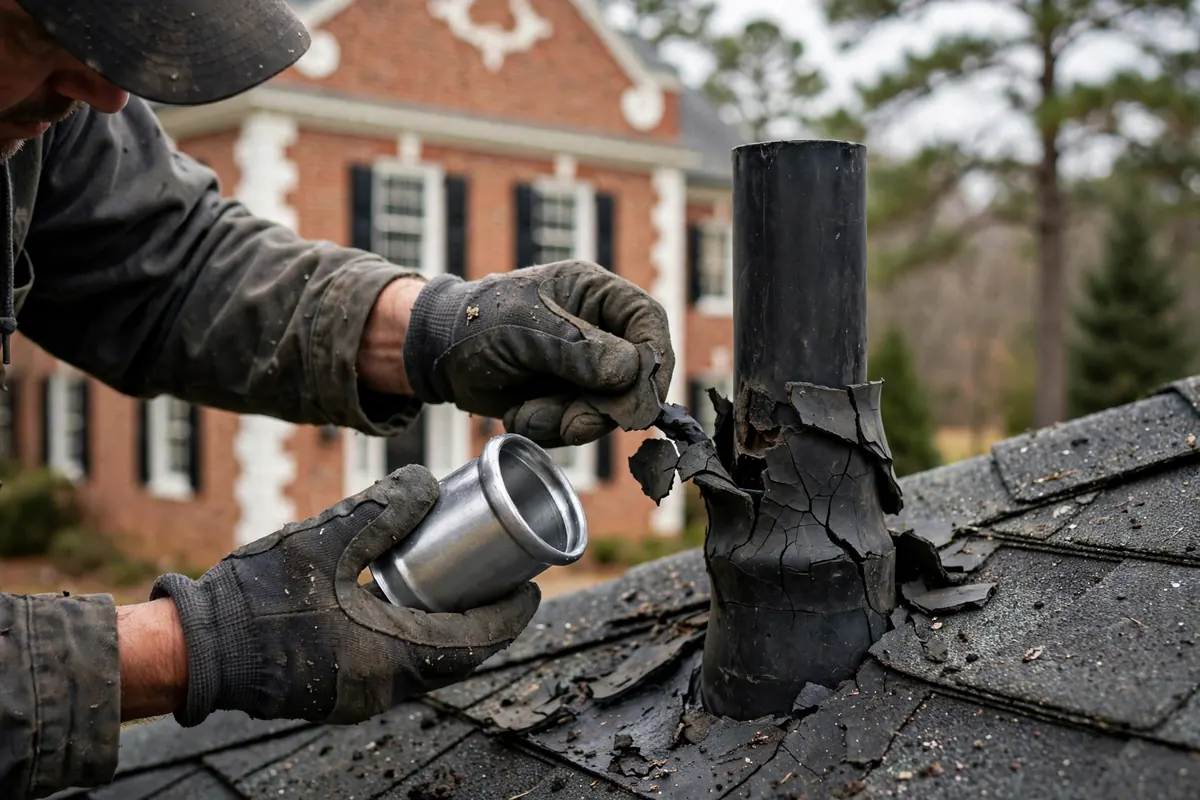
Signs You Need Pipe Boot Repair in Arnold
- A ceiling stain directly below a bathroom or kitchen — right under a plumbing vent.
- A rubber boot around a vent pipe that looks cracked, split, or pulled away from the pipe.
- Daylight visible around the vent pipe from inside the attic.
- Stains that appear with any rain, not just heavy storms — boots leak in drizzle too.
- Multiple small stains in a line below a slope with several vent pipes.
- A boot that slides up and down the pipe loosely instead of gripping it.
Our Pipe Boot Repair Process in Arnold
- Vent-by-vent survey: every pipe, gas vent, and exhaust penetration on the roof is checked — boots tend to fail at similar ages.
- Shingle release: the shingles around the boot are carefully lifted to expose the flange.
- Old boot out: the failed boot and its nails are removed; the deck around the penetration is checked for rot.
- New boot set: a lead or premium synthetic boot is slid over the pipe, flanged under the upslope shingles and over the downslope course.
- Seal and reset: the flange is sealed, shingles are reset and hand-sealed, and nearby boots are graded so you know which are next.
How Arnold Changes This Work
Pipe Boot Repair isn't the same job everywhere — arnold's housing and exposure change what we check, what materials we choose, and where we look first:
- Waterfront-edge homes see wind-driven rain forced under shingle edges and ridge caps — step and headwall flashing gets a harder look here than inland.
- Mature oaks and pines shed limbs and leaf mats into roof valleys; valley metal stays damp and corrodes faster, so valley inspections focus on rust-through and debris dams.
- Many 1980s subdivisions still carry their second shingle layer; tear-off condition of the deck can't be assumed until the old layers come up.
- College Parkway corridor homes with tall pines: pine needles clog gutters and cause backup leaks at the drip edge, often mistaken for roof failure.
Two of those factors deserve emphasis because they most often decide whether pipe boot repair succeeds long-term in Arnold. First, water exposure: storm exposure here is real — driving rain finds every weak lap, so flashing details get marine-grade attention even away from the water, which is why we default to corrosion-resistant metals and wider laps on arnold jobs. Second, access and staging: College Parkway, Ritchie Highway (MD-2), Baltimore Annapolis Blvd (MD-648) routing keeps scheduling tight, but wooded lots mean we plan debris management and ladder placement around mature trees. Both show up in your written estimate as line items, not surprises.
Materials & Methods
- Lead pipe boots — the lifetime option; lead never cracks in UV and forms itself to the pipe.
- Premium synthetic boots with UV-stable collars where lead isn't preferred.
- Stainless fasteners that won't rust-streak the new boot.
- Ice-and-water membrane patches under the flange for a secondary seal.
- Roofing sealant for the top collar-to-pipe joint.
Arnold Snapshot
Arnold (21012) sits in Anne Arundel County, accessed via College Parkway, Ritchie Highway (MD-2), Baltimore Annapolis Blvd (MD-648). Mix of 1970s–1990s subdivisions plus waterfront properties along the Severn River and creeks off the Broadneck Peninsula. Colonials, split-levels and ranches; many original roofs now at or past the 20–25 year mark. Exposed to nor'easters and tropical-system remnants moving up the Chesapeake; wind-driven rain is the top leak trigger. Mature tree canopy drops heavy debris into valleys and gutters each fall. For pipe boot repair specifically, that profile tells us which failure modes to rule out first — and it is why two arnold estimates for the same service can legitimately differ: the roof's age, exposure, and access shape the scope before we ever climb the ladder.
How Long Does Pipe Boot Repair Take in Arnold?
Most boot replacements take 30 to 90 minutes per boot, and we grade every penetration on the roof during the visit. Homes needing several boots are usually done in under two hours total.
Scheduling in Arnold is straightforward: we route via College Parkway, Ritchie Highway (MD-2), Baltimore Annapolis Blvd (MD-648), and arnold sits inside our core service area with the same priority as Severna Park itself. Emergency calls jump the schedule regardless of neighborhood. For non-emergency work, dry-weather scheduling gets you the earliest slot — and the most thorough job, since pipe boot repair can't be properly water-tested on a soaked roof. When you call, tell us your ZIP (21012) and where the water is showing; that lets us arrive with the right materials for arnold's housing — whether that's matching shingles for the local subdivisions, corrosion-resistant flashing for waterfront exposure, or wide valley metal for the tree-heavy streets. Photos of the stain and the roof area above it, texted ahead if you can, make the first visit even more productive.
Safety Notes
- Vent pipes can be hot (furnace and water-heater vents) — we check pipe temperature before handling.
- Gas appliance vents are never sealed airtight at the boot collar; the pipe needs its clearance.
- Brittle shingles around old boots get patient hand work, not pry-bar force.
- Attic verification after replacement confirms the stain path is dry, not just covered.
Related Pages
Pipe Boot Repair — All Areas
How this service works across Severna Park and Anne Arundel County.
Roof Leak Repair in Arnold
All leak repair services available in Arnold, MD 21012.
Emergency Roof Leak Repair in Arnold
When water is coming in now, waiting is not an option. Our emergency roof leak repair service in Sev…
Roof Leak Detection in Arnold
Most roof leaks don't start where the stain appears. Our roof leak detection service in Severna Park…
Shingle Roof Leak Repair in Arnold
Cracked, curled, or wind-torn shingles let water straight through to the deck. Our shingle roof leak…
Pipe Boot Repair in Arnold FAQs
How do I know the boot is the problem and not the shingles?
Location is the giveaway: a stain directly below a vent pipe, especially one that appears even in light rain, points at the boot. During the visit we lift the shingles around the boot and look — a cracked or gapped collar is visible in seconds. If the boot is sound, we keep diagnosing instead of replacing parts blindly.
Should I replace all the boots at once?
If they're the same age and material, usually yes. Boots on the same roof see the same sun and fail within a few years of each other. Doing them in one visit saves you repeat service charges — we'll grade each boot and let you decide with real information.
What's better: lead or rubber boots?
Lead, for longevity — it doesn't crack in UV and lasts decades. Modern premium synthetic boots are a solid second choice with 15-to-20-year life. Standard cheap neoprene is what failed you in the first place; we don't reinstall the problem.
Can a bad boot cause mold in my attic?
Yes. A slow boot leak drips onto insulation and sheathing for months before it stains a ceiling. By the time you see the stain, the attic above it may have sustained mold growth. That's why we check the attic side on every boot call.
What roof leak problems are most common in Arnold?
Waterfront-edge homes see wind-driven rain forced under shingle edges and ridge caps — step and headwall flashing gets a harder look here than inland. Mature oaks and pines shed limbs and leaf mats into roof valleys; valley metal stays damp and corrodes faster, so valley inspections focus on rust-through and debris dams.
How do Arnold's homes affect roof leak repair?
Mix of 1970s–1990s subdivisions plus waterfront properties along the Severn River and creeks off the Broadneck Peninsula. Colonials, split-levels and ranches; many original roofs now at or past the 20–25 year mark. That housing mix shapes the work: Many 1980s subdivisions still carry their second shingle layer; tear-off condition of the deck can't be assumed until the old layers come up.
Roof Leaking? Don't Wait.
Every storm makes it worse. Call now and stop the water today.
Call Now — (888) 974-0663