
Roof Flashing Repair in Benfield, MD 21146
Flashing — the metal that seals roof-to-wall joints, valleys, and edges — causes more leaks than shingles do. Our roof flashing repair in Severna Park, MD replaces rusted, lifted, or missing flashing with properly stepped, sealed metalwork that moves water off the roof instead of into it. In Benfield, that work meets corridor along Benfield Road with a mix of older ranch homes and newer infill colonials on wooded lots. Many homes expanded over the years, creating roof-to-wall junctions where additions meet original structures. Because of that housing mix — and inland Severna Park weather: hot humid summers, freeze-thaw winters, about 44 inches of rain a year. Wooded lots keep north slopes shaded and slow to dry. — roof flashing repair here follows the patterns described below, not a generic checklist.
What that means in practice: the failure patterns we see most in Benfield drive how we scope roof flashing repair here. Addition tie-ins are the number-one leak source here — headwall and sidewall flashing where a newer roof plane meets the original house needs careful step-flashing work. That local read — housing age, tree cover, water exposure, and how benfield's roofs were built — shapes the estimate you get, the materials we bring on the truck, and the order we work in. The sections below walk through exactly what to watch for, how the job runs, and how long it takes on a typical benfield home.
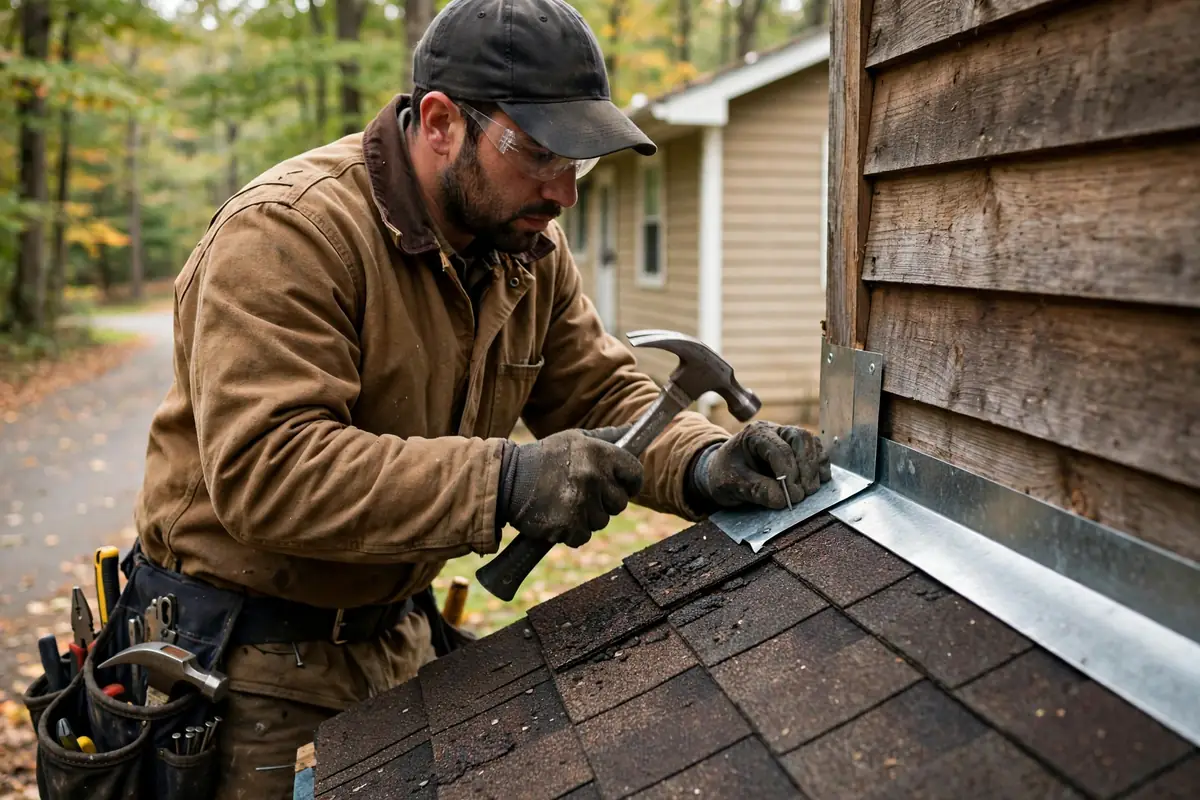
Signs You Need Roof Flashing Repair in Benfield
- Water stains on interior walls where the roof meets a dormer, addition, or chimney.
- Rust streaks running down from roof-to-wall joints or visible on the flashing itself.
- Flashing that has pulled away from the wall, leaving a visible gap.
- Caulk-only 'repairs' smeared over old flashing — a sign the underlying metal already failed.
- Leaks that appear only in wind-driven rain, when water is pushed sideways into joints.
- Missing kick-out flashing where a roof slope dies into a sidewall, with stained siding below.
Our Roof Flashing Repair Process in Benfield
- Full flashing survey: step flashing, headwall, sidewall, valley, drip edge, and rake — every line is photographed and graded.
- Siding and shingle release: surrounding materials are carefully lifted so new flashing can integrate correctly, not just surface-mount.
- Old metal out: corroded or improperly installed flashing is removed back to sound material.
- New metal in: step flashing woven with each shingle course, headwall flashing with proper laps, and counter-flashing reglet-cut into masonry where applicable.
- Seal and integrate: joints are sealed, shingles and siding are reset, and the repair is water-tested with a hose before closeout.
How Benfield Changes This Work
Roof Flashing Repair isn't the same job everywhere — benfield's housing and exposure change what we check, what materials we choose, and where we look first:
- Addition tie-ins are the number-one leak source here — headwall and sidewall flashing where a newer roof plane meets the original house needs careful step-flashing work.
- Shaded, slow-drying north slopes grow moss and algae that lift shingle edges; treatment and zinc strips are discussed more here than on sunny lots.
- Older ranch homes often have low-slope rear sections where standard shingles were used below their rated pitch — those spots need membrane or low-slope solutions.
- Wooded lots mean falling branches; impact-damaged shingles and punctured pipe boots show up after every wind event.
Two of those factors deserve emphasis because they most often decide whether roof flashing repair succeeds long-term in Benfield. First, water exposure: storm exposure here is real — driving rain finds every weak lap, so flashing details get marine-grade attention even away from the water, which is why we default to corrosion-resistant metals and wider laps on benfield jobs. Second, access and staging: Benfield Road, Baltimore Annapolis Blvd (MD-648), Jumpers Hole Road routing keeps scheduling tight, but wooded lots mean we plan debris management and ladder placement around mature trees. Both show up in your written estimate as line items, not surprises.
Materials & Methods
- 26-gauge galvanized or aluminum step flashing, sized to the shingle exposure.
- Copper or stainless options for waterfront homes where salt air eats standard metals.
- Lead or formable flashing for irregular masonry joints and old chimney shoulders.
- High-quality polyurethane sealant — never plain silicone smeared as a substitute for metal.
- Kick-out flashing diverters that throw runoff into the gutter instead of behind siding.
Benfield Snapshot
Benfield (21146) sits in Anne Arundel County, accessed via Benfield Road, Baltimore Annapolis Blvd (MD-648), Jumpers Hole Road. Corridor along Benfield Road with a mix of older ranch homes and newer infill colonials on wooded lots. Many homes expanded over the years, creating roof-to-wall junctions where additions meet original structures. Inland Severna Park weather: hot humid summers, freeze-thaw winters, about 44 inches of rain a year. Wooded lots keep north slopes shaded and slow to dry. For roof flashing repair specifically, that profile tells us which failure modes to rule out first — and it is why two benfield estimates for the same service can legitimately differ: the roof's age, exposure, and access shape the scope before we ever climb the ladder.
How Long Does Roof Flashing Repair Take in Benfield?
Flashing repairs are typically half-day jobs: release the surrounding materials, remove the failed metal, cut and fit new flashing, and reset everything. Chimney-adjacent or multi-wall flashing can extend into a full day.
Scheduling in Benfield is straightforward: we route via Benfield Road, Baltimore Annapolis Blvd (MD-648), Jumpers Hole Road, and benfield sits inside our core service area with the same priority as Severna Park itself. Emergency calls jump the schedule regardless of neighborhood. For non-emergency work, dry-weather scheduling gets you the earliest slot — and the most thorough job, since roof flashing repair can't be properly water-tested on a soaked roof. When you call, tell us your ZIP (21146) and where the water is showing; that lets us arrive with the right materials for benfield's housing — whether that's matching shingles for the local subdivisions, corrosion-resistant flashing for waterfront exposure, or wide valley metal for the tree-heavy streets. Photos of the stain and the roof area above it, texted ahead if you can, make the first visit even more productive.
Safety Notes
- Masonry reglet cuts are made with dust control and eye protection — silica dust is no joke.
- Siding is lifted, not torn; we carry the common local siding profiles' removal tools.
- Old flashing edges are sharp — cut-resistant gloves on every flashing job.
- Ladder stabilizers protect gutters and siding at every access point.
Related Pages
Roof Flashing Repair — All Areas
How this service works across Severna Park and Anne Arundel County.
Roof Leak Repair in Benfield
All leak repair services available in Benfield, MD 21146.
Emergency Roof Leak Repair in Benfield
When water is coming in now, waiting is not an option. Our emergency roof leak repair service in Sev…
Roof Leak Detection in Benfield
Most roof leaks don't start where the stain appears. Our roof leak detection service in Severna Park…
Shingle Roof Leak Repair in Benfield
Cracked, curled, or wind-torn shingles let water straight through to the deck. Our shingle roof leak…
Roof Flashing Repair in Benfield FAQs
Why does flashing fail before the shingles do?
Flashing is thinner metal doing a harder job — it bridges moving joints between different materials (roof to wall, roof to chimney) that expand and contract at different rates. Galvanized coatings wear off, caulk joints fatigue, and wind works edges loose. On a 25-year roof, expect flashing to need attention at least once mid-life.
Can't you just reseal the old flashing with caulk?
If the metal is sound and only the sealant joint failed, resealing is legitimate. But caulk over rusted-through or missing flashing is a bandage on a broken bone — it will leak again, usually at the worst time. We show you photos of the metal's actual condition so you can see which situation you're in.
What is step flashing and why does it matter?
Step flashing is a series of small L-shaped metal pieces woven between each shingle course where a roof meets a wall. Each piece overlaps the one below, so water steps down and off the roof. One continuous bent strip — the common shortcut — can't flex with the joint and eventually opens a channel straight into the house.
My siding is stained below a roof joint. Is that a flashing problem?
Very likely, especially if there's no kick-out flashing where the roof meets the wall. Without that small diverter, roof runoff pours behind the siding, rots the sheathing, and shows up as a 'roof leak' inside. The fix is proper kick-out flashing, not new siding.
What roof leak problems are most common in Benfield?
Addition tie-ins are the number-one leak source here — headwall and sidewall flashing where a newer roof plane meets the original house needs careful step-flashing work. Shaded, slow-drying north slopes grow moss and algae that lift shingle edges; treatment and zinc strips are discussed more here than on sunny lots.
How do Benfield's homes affect roof leak repair?
Corridor along Benfield Road with a mix of older ranch homes and newer infill colonials on wooded lots. Many homes expanded over the years, creating roof-to-wall junctions where additions meet original structures. That housing mix shapes the work: Older ranch homes often have low-slope rear sections where standard shingles were used below their rated pitch — those spots need membrane or low-slope solutions.
Roof Leaking? Don't Wait.
Every storm makes it worse. Call now and stop the water today.
Call Now — (888) 974-0663