
Roof Flashing Repair in Cypress Creek, MD 21146
Flashing — the metal that seals roof-to-wall joints, valleys, and edges — causes more leaks than shingles do. Our roof flashing repair in Severna Park, MD replaces rusted, lifted, or missing flashing with properly stepped, sealed metalwork that moves water off the roof instead of into it. In Cypress Creek, that work meets waterfront community on Cypress Creek off the Magothy River. Mix of mid-century waterfront homes and newer rebuilds; elevated exposure to wind off the water. Because of that housing mix — and open-water wind exposure drives rain sideways into roof edges; salt air accelerates corrosion of exposed metal — flashing, fasteners and vents. — roof flashing repair here follows the patterns described below, not a generic checklist.
What that means in practice: the failure patterns we see most in Cypress Creek drive how we scope roof flashing repair here. Salt air pits and corrodes standard galvanized flashing within years; stainless or copper flashing details last far longer on waterfront homes here. That local read — housing age, tree cover, water exposure, and how cypress creek's roofs were built — shapes the estimate you get, the materials we bring on the truck, and the order we work in. The sections below walk through exactly what to watch for, how the job runs, and how long it takes on a typical cypress creek home.
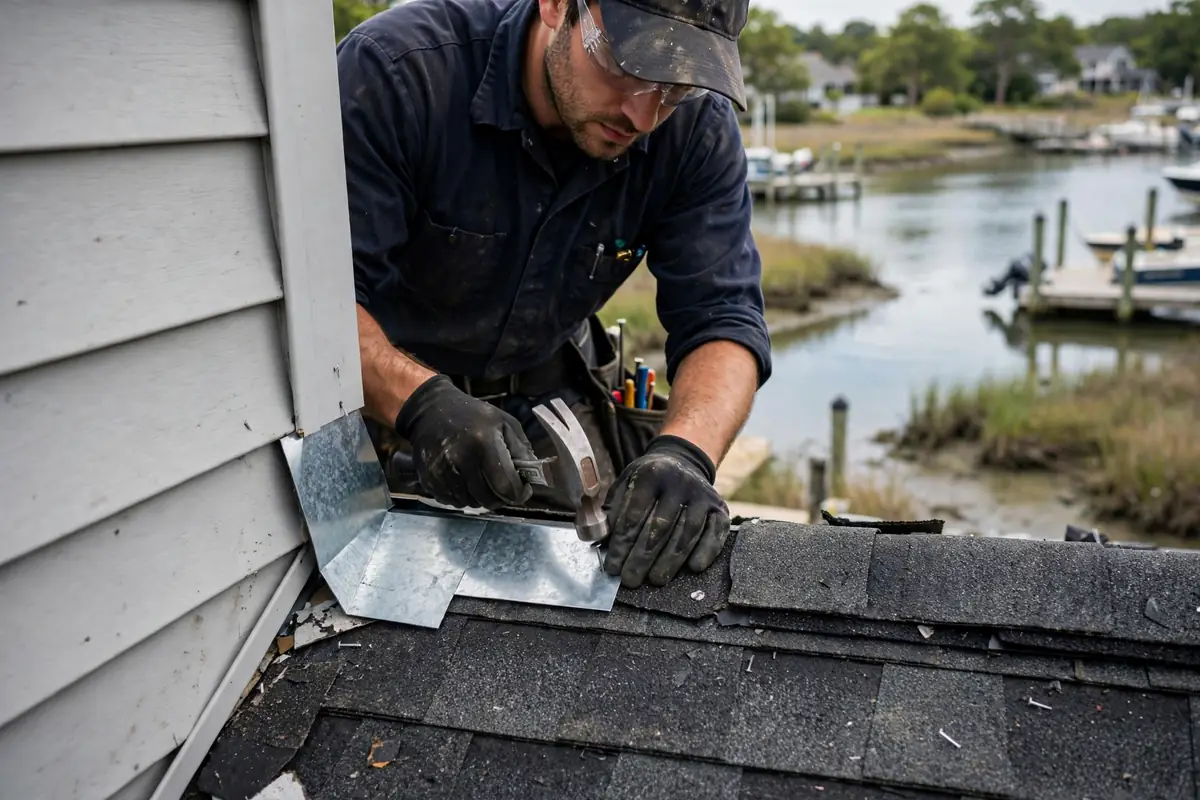
Signs You Need Roof Flashing Repair in Cypress Creek
- Water stains on interior walls where the roof meets a dormer, addition, or chimney.
- Rust streaks running down from roof-to-wall joints or visible on the flashing itself.
- Flashing that has pulled away from the wall, leaving a visible gap.
- Caulk-only 'repairs' smeared over old flashing — a sign the underlying metal already failed.
- Leaks that appear only in wind-driven rain, when water is pushed sideways into joints.
- Missing kick-out flashing where a roof slope dies into a sidewall, with stained siding below.
Our Roof Flashing Repair Process in Cypress Creek
- Full flashing survey: step flashing, headwall, sidewall, valley, drip edge, and rake — every line is photographed and graded.
- Siding and shingle release: surrounding materials are carefully lifted so new flashing can integrate correctly, not just surface-mount.
- Old metal out: corroded or improperly installed flashing is removed back to sound material.
- New metal in: step flashing woven with each shingle course, headwall flashing with proper laps, and counter-flashing reglet-cut into masonry where applicable.
- Seal and integrate: joints are sealed, shingles and siding are reset, and the repair is water-tested with a hose before closeout.
How Cypress Creek Changes This Work
Roof Flashing Repair isn't the same job everywhere — cypress creek's housing and exposure change what we check, what materials we choose, and where we look first:
- Salt air pits and corrodes standard galvanized flashing within years; stainless or copper flashing details last far longer on waterfront homes here.
- Wind-driven rain exploits any lifted shingle tab along rakes and eaves — seal-down condition is checked on every visit.
- Bulkhead and seawall-adjacent homes sit low; wind-blown spray keeps lower roof edges and gutters wet long after rain stops.
- Older waterfront cottages converted to year-round homes often have pieced-together roof framing where dormers were added — valley and tie-in flashing is critical.
Two of those factors deserve emphasis because they most often decide whether roof flashing repair succeeds long-term in Cypress Creek. First, water exposure: waterfront and creek-side homes take wind-driven rain and salt air that ages flashing and fasteners faster than the same roof would age inland, which is why we default to corrosion-resistant metals and wider laps on cypress creek jobs. Second, access and staging: Cypress Creek area roads off the Magothy shoreline, Baltimore Annapolis Blvd (MD-648) routing keeps scheduling tight, but established landscaping means we plan protection and staging before the first shingle comes off. Both show up in your written estimate as line items, not surprises.
Materials & Methods
- 26-gauge galvanized or aluminum step flashing, sized to the shingle exposure.
- Copper or stainless options for waterfront homes where salt air eats standard metals.
- Lead or formable flashing for irregular masonry joints and old chimney shoulders.
- High-quality polyurethane sealant — never plain silicone smeared as a substitute for metal.
- Kick-out flashing diverters that throw runoff into the gutter instead of behind siding.
Cypress Creek Snapshot
Cypress Creek (21146) sits in Anne Arundel County, accessed via Cypress Creek area roads off the Magothy shoreline, Baltimore Annapolis Blvd (MD-648). Waterfront community on Cypress Creek off the Magothy River. Mix of mid-century waterfront homes and newer rebuilds; elevated exposure to wind off the water. Open-water wind exposure drives rain sideways into roof edges; salt air accelerates corrosion of exposed metal — flashing, fasteners and vents. For roof flashing repair specifically, that profile tells us which failure modes to rule out first — and it is why two cypress creek estimates for the same service can legitimately differ: the roof's age, exposure, and access shape the scope before we ever climb the ladder.
How Long Does Roof Flashing Repair Take in Cypress Creek?
Flashing repairs are typically half-day jobs: release the surrounding materials, remove the failed metal, cut and fit new flashing, and reset everything. Chimney-adjacent or multi-wall flashing can extend into a full day.
Scheduling in Cypress Creek is straightforward: we route via Cypress Creek area roads off the Magothy shoreline, Baltimore Annapolis Blvd (MD-648), and cypress creek sits inside our core service area with the same priority as Severna Park itself. Emergency calls jump the schedule regardless of neighborhood. For non-emergency work, dry-weather scheduling gets you the earliest slot — and the most thorough job, since roof flashing repair can't be properly water-tested on a soaked roof. When you call, tell us your ZIP (21146) and where the water is showing; that lets us arrive with the right materials for cypress creek's housing — whether that's matching shingles for the local subdivisions, corrosion-resistant flashing for waterfront exposure, or wide valley metal for the tree-heavy streets. Photos of the stain and the roof area above it, texted ahead if you can, make the first visit even more productive.
Safety Notes
- Masonry reglet cuts are made with dust control and eye protection — silica dust is no joke.
- Siding is lifted, not torn; we carry the common local siding profiles' removal tools.
- Old flashing edges are sharp — cut-resistant gloves on every flashing job.
- Ladder stabilizers protect gutters and siding at every access point.
Related Pages
Roof Flashing Repair — All Areas
How this service works across Severna Park and Anne Arundel County.
Roof Leak Repair in Cypress Creek
All leak repair services available in Cypress Creek, MD 21146.
Emergency Roof Leak Repair in Cypress Creek
When water is coming in now, waiting is not an option. Our emergency roof leak repair service in Sev…
Roof Leak Detection in Cypress Creek
Most roof leaks don't start where the stain appears. Our roof leak detection service in Severna Park…
Shingle Roof Leak Repair in Cypress Creek
Cracked, curled, or wind-torn shingles let water straight through to the deck. Our shingle roof leak…
Roof Flashing Repair in Cypress Creek FAQs
Why does flashing fail before the shingles do?
Flashing is thinner metal doing a harder job — it bridges moving joints between different materials (roof to wall, roof to chimney) that expand and contract at different rates. Galvanized coatings wear off, caulk joints fatigue, and wind works edges loose. On a 25-year roof, expect flashing to need attention at least once mid-life.
Can't you just reseal the old flashing with caulk?
If the metal is sound and only the sealant joint failed, resealing is legitimate. But caulk over rusted-through or missing flashing is a bandage on a broken bone — it will leak again, usually at the worst time. We show you photos of the metal's actual condition so you can see which situation you're in.
What is step flashing and why does it matter?
Step flashing is a series of small L-shaped metal pieces woven between each shingle course where a roof meets a wall. Each piece overlaps the one below, so water steps down and off the roof. One continuous bent strip — the common shortcut — can't flex with the joint and eventually opens a channel straight into the house.
My siding is stained below a roof joint. Is that a flashing problem?
Very likely, especially if there's no kick-out flashing where the roof meets the wall. Without that small diverter, roof runoff pours behind the siding, rots the sheathing, and shows up as a 'roof leak' inside. The fix is proper kick-out flashing, not new siding.
What roof leak problems are most common in Cypress Creek?
Salt air pits and corrodes standard galvanized flashing within years; stainless or copper flashing details last far longer on waterfront homes here. Wind-driven rain exploits any lifted shingle tab along rakes and eaves — seal-down condition is checked on every visit.
How do Cypress Creek's homes affect roof leak repair?
Waterfront community on Cypress Creek off the Magothy River. Mix of mid-century waterfront homes and newer rebuilds; elevated exposure to wind off the water. That housing mix shapes the work: Bulkhead and seawall-adjacent homes sit low; wind-blown spray keeps lower roof edges and gutters wet long after rain stops.
Roof Leaking? Don't Wait.
Every storm makes it worse. Call now and stop the water today.
Call Now — (888) 974-0663