
Roof Leak Detection in Round Bay, MD 21146
Most roof leaks don't start where the stain appears. Our roof leak detection service in Severna Park, MD traces water to its true entry point using moisture meters, thermal imaging, and controlled water testing — so the repair fixes the cause, not the symptom. In Round Bay, that work meets waterfront community on the Severn River: mid-century homes, many renovated and expanded over the decades. Community beaches and a classic Bay-country feel. Because of that housing mix — and river-front humidity and wind; summer thunderstorms roll straight up the Severn. Tall riverside trees drop limbs in storms. — roof leak detection here follows the patterns described below, not a generic checklist.
What that means in practice: the failure patterns we see most in Round Bay drive how we scope roof leak detection here. Decades of renovations mean layered roof histories — an addition's valley may be flashed over two older systems; repairs peel back to sound structure. That local read — housing age, tree cover, water exposure, and how round bay's roofs were built — shapes the estimate you get, the materials we bring on the truck, and the order we work in. The sections below walk through exactly what to watch for, how the job runs, and how long it takes on a typical round bay home.
Signs You Need Roof Leak Detection in Round Bay
- A ceiling stain that keeps coming back after someone already 'fixed' the roof above it.
- Musty attic smell or damp insulation with no visible hole in the roof.
- Stains that appear only in wind-driven rain but not in gentle rain.
- Water showing up far from any obvious roof feature — mid-ceiling with no vent or chimney nearby.
- Peeling paint or bubbling drywall tape on an upstairs ceiling or wall.
- Mold spots on attic sheathing visible during a routine look in the attic.
Our Roof Leak Detection Process in Round Bay
- Interior mapping: we document every stain, measure moisture in drywall and framing, and note the slope direction above each mark.
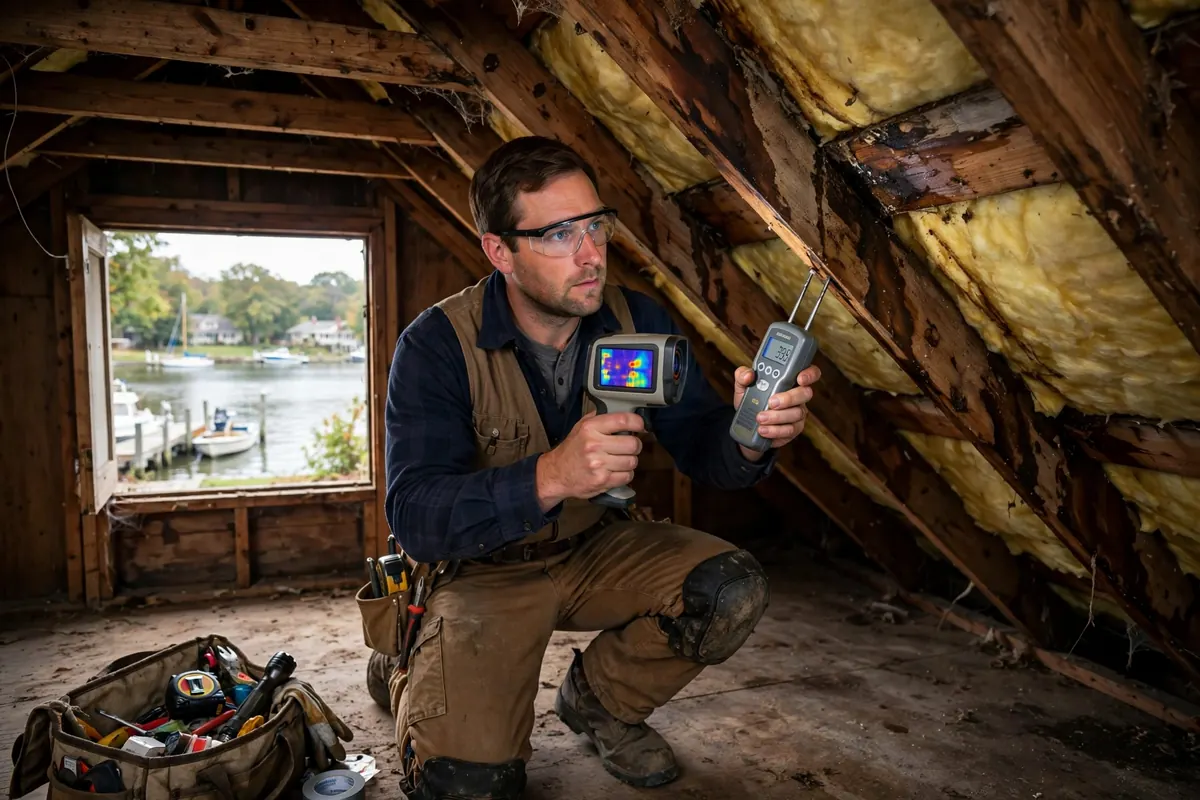
- Attic inspection: with lights off, we look for daylight penetrations, then scan sheathing with a thermal camera and pin meter for hidden wet zones.
- Exterior candidate survey: every upslope penetration, flashing line, and valley above the wet zone is photographed and graded.
- Controlled water testing: working from the lowest candidate upward, we soak one suspect area at a time while a second tech watches inside — isolating the true entry.
- Repair plan with evidence: you get photos of the entry point, moisture readings, and a repair scope tied to what we found — not a guess.
How Round Bay Changes This Work
Roof Leak Detection isn't the same job everywhere — round bay's housing and exposure change what we check, what materials we choose, and where we look first:
- Decades of renovations mean layered roof histories — an addition's valley may be flashed over two older systems; repairs peel back to sound structure.
- Riverside tree cover drops branches that crack shingles and dent metal valleys; post-storm inspections are a regular service here.
- Renovated homes with new dormers need kick-out flashing where roof meets wall, or water runs behind siding and shows up as a 'roof leak' inside.
- Cedar shake accents on some renovated homes need different detailing than the surrounding asphalt — transitions are checked closely.
Two of those factors deserve emphasis because they most often decide whether roof leak detection succeeds long-term in Round Bay. First, water exposure: waterfront and creek-side homes take wind-driven rain and salt air that ages flashing and fasteners faster than the same roof would age inland, which is why we default to corrosion-resistant metals and wider laps on round bay jobs. Second, access and staging: Round Bay Road, Baltimore Annapolis Blvd (MD-648) routing keeps scheduling tight, but wooded lots mean we plan debris management and ladder placement around mature trees. Both show up in your written estimate as line items, not surprises.
Materials & Methods
- Pin and pinless moisture meters that map how far water has traveled through sheathing and framing.
- Thermal imaging camera that reveals cool, damp zones invisible to the naked eye.
- Controlled water-test setup with adjustable spray to simulate wind-driven rain on one suspect area at a time.
- Chalk and photo documentation so the entry point is marked and recorded before repair.
- Core sampling tools for flat and low-slope sections where layered membranes hide the leak path.
Round Bay Snapshot
Round Bay (21146) sits in Anne Arundel County, accessed via Round Bay Road, Baltimore Annapolis Blvd (MD-648). Waterfront community on the Severn River: mid-century homes, many renovated and expanded over the decades. Community beaches and a classic Bay-country feel. River-front humidity and wind; summer thunderstorms roll straight up the Severn. Tall riverside trees drop limbs in storms. For roof leak detection specifically, that profile tells us which failure modes to rule out first — and it is why two round bay estimates for the same service can legitimately differ: the roof's age, exposure, and access shape the scope before we ever climb the ladder.
How Long Does Roof Leak Detection Take in Round Bay?
Most detection visits take one to two hours: interior mapping, attic scan, exterior survey, and controlled water testing. Complex rooflines or finished attics with no access can extend the visit, and we'll tell you that upfront before starting.
Scheduling in Round Bay is straightforward: we route via Round Bay Road, Baltimore Annapolis Blvd (MD-648), and round bay sits inside our core service area with the same priority as Severna Park itself. Emergency calls jump the schedule regardless of neighborhood. For non-emergency work, dry-weather scheduling gets you the earliest slot — and the most thorough job, since roof leak detection can't be properly water-tested on a soaked roof. When you call, tell us your ZIP (21146) and where the water is showing; that lets us arrive with the right materials for round bay's housing — whether that's matching shingles for the local subdivisions, corrosion-resistant flashing for waterfront exposure, or wide valley metal for the tree-heavy streets. Photos of the stain and the roof area above it, texted ahead if you can, make the first visit even more productive.
Safety Notes
- Attic inspections stay on joists and walk boards — stepping between joists can put a foot through the ceiling below.
- Thermal cameras see temperature, not water directly; readings are always confirmed with a physical moisture meter.
- Water testing is done in controlled sections, never by flooding a whole roof slope at once.
- If mold is found on sheathing, we note it and recommend proper remediation rather than just covering it up.
Related Pages
Roof Leak Detection — All Areas
How this service works across Severna Park and Anne Arundel County.
Roof Leak Repair in Round Bay
All leak repair services available in Round Bay, MD 21146.
Emergency Roof Leak Repair in Round Bay
When water is coming in now, waiting is not an option. Our emergency roof leak repair service in Sev…
Shingle Roof Leak Repair in Round Bay
Cracked, curled, or wind-torn shingles let water straight through to the deck. Our shingle roof leak…
Roof Flashing Repair in Round Bay
Flashing — the metal that seals roof-to-wall joints, valleys, and edges — causes more leaks than shi…
Roof Leak Detection in Round Bay FAQs
Why does my ceiling stain keep coming back after repairs?
Because the repair addressed the symptom, not the entry point. Water can travel several feet along a rafter or underlayment before it drops onto drywall. Until the actual breach is found with meters and testing, patching the visible stain area just moves the problem.
Can you find a leak if it's not raining?
Yes — in fact dry weather is better. Thermal imaging and moisture meters detect residual dampness in sheathing and insulation, and controlled water testing recreates rain on demand, one suspect area at a time. We don't need a storm to find your leak.
How long does a detection visit take?
Most single-family homes in Severna Park take one to two hours: interior mapping, attic scan, exterior survey, and water testing. Complex rooflines with multiple valleys or finished attics can take longer, and we'll tell you that upfront.
Will water testing damage my roof?
No. We apply water to small, controlled sections starting at the lowest suspect point — less water than a normal rainstorm delivers. The test is designed to reveal the entry, not to stress the roof.
What roof leak problems are most common in Round Bay?
Decades of renovations mean layered roof histories — an addition's valley may be flashed over two older systems; repairs peel back to sound structure. Riverside tree cover drops branches that crack shingles and dent metal valleys; post-storm inspections are a regular service here.
How do Round Bay's homes affect roof leak repair?
Waterfront community on the Severn River: mid-century homes, many renovated and expanded over the decades. Community beaches and a classic Bay-country feel. That housing mix shapes the work: Renovated homes with new dormers need kick-out flashing where roof meets wall, or water runs behind siding and shows up as a 'roof leak' inside.
Roof Leaking? Don't Wait.
Every storm makes it worse. Call now and stop the water today.
Call Now — (888) 974-0663