
Roof Valley Leak Repair in Chartwell, MD 21146
Valleys carry the combined runoff of two roof slopes, so any weakness there leaks fast and big. Our roof valley leak repair in Severna Park, MD clears debris dams, replaces corroded or undersized valley metal, and reweaves the valley shingles for a channel that actually drains. In Chartwell, that work meets planned 1960s–1970s community of brick ranchers and colonials with established landscaping. Most homes are on their second or third roof; original builders used basic 3-tab shingles and galvanized flashing. Because of that housing mix — and typical Severna Park pattern: summer thunderstorms with driving rain, winter freeze-thaw cycling, occasional tropical-storm remnants. — roof valley leak repair here follows the patterns described below, not a generic checklist.
What that means in practice: the failure patterns we see most in Chartwell drive how we scope roof valley leak repair here. Original galvanized step flashing from the 60s/70s is usually rusted through by now — flashing replacement, not just shingle work, is routine on these homes. That local read — housing age, tree cover, water exposure, and how chartwell's roofs were built — shapes the estimate you get, the materials we bring on the truck, and the order we work in. The sections below walk through exactly what to watch for, how the job runs, and how long it takes on a typical chartwell home.
Signs You Need Roof Valley Leak Repair in Chartwell
- A ceiling stain or wall streak directly below where two roof slopes meet.
- Visible rust, holes, or lifted edges on the metal in a valley.
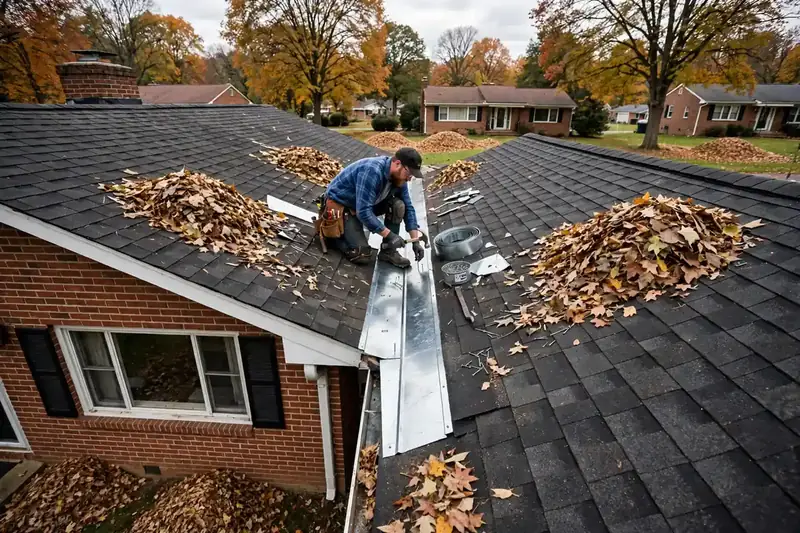
- Leaves and debris packed into a valley that never fully clears.
- Shingles curling or lifting along the valley edges.
- Water overshooting the gutter at the bottom of a valley during heavy rain.
- Moss or algae growing in a thick band along a valley — it stays wet there.
Our Roof Valley Leak Repair Process in Chartwell
- Valley mapping: every valley is walked (when safe) and photographed; debris dams are noted before anything is disturbed.
- Debris clearing: packed leaves, pine needles, and granule sediment are removed so we can see the metal and shingle condition.
- Metal assessment: the valley metal is checked for rust-through, pinholes, and proper width — undersized metal is a common original defect.
- Rebuild: failed metal is replaced with wide valley flashing; shingles are cut back to a clean, straight waterline and re-woven or closed-cut per best practice.
- Flow test: water is run down both slopes to confirm the valley drains cleanly into the gutter without overshoot.
How Chartwell Changes This Work
Roof Valley Leak Repair isn't the same job everywhere — chartwell's housing and exposure change what we check, what materials we choose, and where we look first:
- Original galvanized step flashing from the 60s/70s is usually rusted through by now — flashing replacement, not just shingle work, is routine on these homes.
- Brick veneer walls mean counter-flashing must be reglet-cut into mortar joints; surface-mounted flashing fails early here.
- Many homes have original masonry chimneys with deteriorated mortar crowns — chimney flashing rebuilds pair naturally with crown repair.
- Low-pitch ranch sections over garages and porches often leak at the transition; those get membrane-compatible detailing.
Two of those factors deserve emphasis because they most often decide whether roof valley leak repair succeeds long-term in Chartwell. First, water exposure: storm exposure here is real — driving rain finds every weak lap, so flashing details get marine-grade attention even away from the water, which is why we default to corrosion-resistant metals and wider laps on chartwell jobs. Second, access and staging: Baltimore Annapolis Blvd (MD-648), Chartwell-area side streets off the B&A corridor routing keeps scheduling tight, but established landscaping means we plan protection and staging before the first shingle comes off. Both show up in your written estimate as line items, not surprises.
Materials & Methods
- Wide (24-inch) valley metal — galvanized, aluminum, or copper — replacing the narrow stock many builders used.
- Ice-and-water membrane under the full valley length as a secondary barrier.
- Closed-cut or woven shingle technique matched to the existing roof style.
- Gutter and downspout check at the valley outlet — a clogged outlet backs water up into the valley.
- Moss treatment for shaded valleys where growth lifts shingle edges.
Chartwell Snapshot
Chartwell (21146) sits in Anne Arundel County, accessed via Baltimore Annapolis Blvd (MD-648), Chartwell-area side streets off the B&A corridor. Planned 1960s–1970s community of brick ranchers and colonials with established landscaping. Most homes are on their second or third roof; original builders used basic 3-tab shingles and galvanized flashing. Typical Severna Park pattern: summer thunderstorms with driving rain, winter freeze-thaw cycling, occasional tropical-storm remnants. For roof valley leak repair specifically, that profile tells us which failure modes to rule out first — and it is why two chartwell estimates for the same service can legitimately differ: the roof's age, exposure, and access shape the scope before we ever climb the ladder.
How Long Does Roof Valley Leak Repair Take in Chartwell?
Valley rebuilds are full-day jobs done right: debris clearing, full-length wide metal replacement over membrane, shingle reweaving, and a flow test before closeout.
Scheduling in Chartwell is straightforward: we route via Baltimore Annapolis Blvd (MD-648), Chartwell-area side streets off the B&A corridor, and chartwell sits inside our core service area with the same priority as Severna Park itself. Emergency calls jump the schedule regardless of neighborhood. For non-emergency work, dry-weather scheduling gets you the earliest slot — and the most thorough job, since roof valley leak repair can't be properly water-tested on a soaked roof. When you call, tell us your ZIP (21146) and where the water is showing; that lets us arrive with the right materials for chartwell's housing — whether that's matching shingles for the local subdivisions, corrosion-resistant flashing for waterfront exposure, or wide valley metal for the tree-heavy streets. Photos of the stain and the roof area above it, texted ahead if you can, make the first visit even more productive.
Safety Notes
- Valleys concentrate water and grow algae — they're the slickest part of any roof, and we treat them that way.
- Debris removal is done with the gutter outlet confirmed clear first, so dislodged material doesn't dam the downspout.
- Old valley metal edges are razor-sharp; cut-resistant gloves throughout.
- We never pressure-wash a valley — the blast drives water under shingles and voids shingle warranties.
Related Pages
Roof Valley Leak Repair — All Areas
How this service works across Severna Park and Anne Arundel County.
Roof Leak Repair in Chartwell
All leak repair services available in Chartwell, MD 21146.
Emergency Roof Leak Repair in Chartwell
When water is coming in now, waiting is not an option. Our emergency roof leak repair service in Sev…
Roof Leak Detection in Chartwell
Most roof leaks don't start where the stain appears. Our roof leak detection service in Severna Park…
Shingle Roof Leak Repair in Chartwell
Cracked, curled, or wind-torn shingles let water straight through to the deck. Our shingle roof leak…
Roof Valley Leak Repair in Chartwell FAQs
Why do valleys leak more than the rest of the roof?
Volume. A valley drains two entire slopes, so it sees multiples of the water any field shingle sees. Any small defect — a pinhole in the metal, a debris dam, a lifted shingle edge — gets tested by far more water, far more often.
Can you just clean the valley instead of rebuilding it?
If the metal is sound and the shingles are intact, a thorough cleaning plus minor resealing is the right call — and we'll tell you when that's the case. But cleaning won't fix rusted-through metal or shingles cut too close to the waterline. We photograph what we find so you can see the difference.
What is the difference between open and closed valleys?
An open valley shows the metal channel with shingles cut back from it; a closed valley weaves or laps shingles across. Open valleys handle heavy debris and water volume better and make future inspection easy — we generally recommend open metal valleys for Severna Park's tree cover and storm volume.
How wide should valley metal be?
Wider than most builders installed. We use 24-inch metal so there's real drainage channel even after shingles are cut back to the waterline. Narrow 12-inch stock leaves almost no channel once shingles encroach — a common original defect on local 70s–90s homes.
What roof leak problems are most common in Chartwell?
Original galvanized step flashing from the 60s/70s is usually rusted through by now — flashing replacement, not just shingle work, is routine on these homes. Brick veneer walls mean counter-flashing must be reglet-cut into mortar joints; surface-mounted flashing fails early here.
How do Chartwell's homes affect roof leak repair?
Planned 1960s–1970s community of brick ranchers and colonials with established landscaping. Most homes are on their second or third roof; original builders used basic 3-tab shingles and galvanized flashing. That housing mix shapes the work: Many homes have original masonry chimneys with deteriorated mortar crowns — chimney flashing rebuilds pair naturally with crown repair.
Roof Leaking? Don't Wait.
Every storm makes it worse. Call now and stop the water today.
Call Now — (888) 974-0663